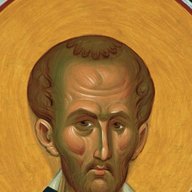
St. John ChrysostomHomily 3 on 1 Thessalonians · on 1 Thessalonians 3:1–2
"Wherefore, when we could no longer forbear, we thought it good to be left behind at Athens alone. And sent Timothy, our brother and God's minister and our fellow-worker in the Gospel of Christ." Instead of saying, "we chose." And this he says, not as extolling Timothy, but honoring them, that he sent them the…
And sent Timotheus, our brother, and minister of God, and our fellowlabourer in the gospel of Christ, to establish you, and to comfort you concerning your faith:
St. John ChrysostomHomily 3 on 1 Thessalonians · on 1 Thessalonians 3:3–4
"That no man be moved by these afflictions; for yourselves know that hereunto we are appointed. For verily, when we were with you, we told you beforehand that we are to suffer affliction; even as it came to pass, and ye know." What then does he say here? Because the temptations of the teachers trouble their disciples,…
St. John ChrysostomHomily 4 on 1 Thessalonians · on 1 Thessalonians 3:5
"For this cause I also, when I could no longer forbear, sent that I might know your faith, lest by any means the tempter had tempted you, and our labor should be in vain." A Question lies before us to-day, which is much disputed, and which is gathered from many sources. But what is this question? "For this cause," he…
But now when Timotheus came from you unto us, and brought us good tidings of your faith and charity, and that ye have good remembrance of us always, desiring greatly to see us, as we also to see you:
St. John ChrysostomHomily 4 on 1 Thessalonians · on 1 Thessalonians 3:6
"But when Timothy came even now unto us from you, and brought us glad tidings of your faith and love, and that ye have good remembrance of us always, longing to see us, even as we also to see you." "Brought us glad tidings," he says. Do you see the excessive joy of Paul? he does not say, brought us word, but "brought…
St. John ChrysostomHomily 4 on 1 Thessalonians · on 1 Thessalonians 3:7–8
"For this cause, brethren, we were comforted over you in all our distress and affliction through your faith: for now we live, if ye stand fast in the Lord." What is comparable to Paul, who thought the salvation of his neighbors was his own, being so affected towards all, as really towards members? He did not require…
St. John ChrysostomHomily 4 on 1 Thessalonians · on 1 Thessalonians 3:9–10
"For what thanksgiving can we render again unto God for you, for all the joy wherewith we joy for your sakes before our God; night and day praying exceedingly that we may see your face, and may perfect that which is lacking in your faith?" Not only, he says, are ye the causes of life to us, but also of much joy, and…
St. John ChrysostomHomily 4 on 1 Thessalonians · on 1 Thessalonians 3:11–12
"Now may our God and Father Himself, and our Lord Jesus Christ direct our way unto you: and the Lord make you to increase and abound in love one toward another, and toward all men, even as we also do toward you." This is a proof of excessive love, that he not only prays for them by himself, but even in his Epistles…
To the end he may stablish your hearts unblameable in holiness before God, even our Father, at the coming of our Lord Jesus Christ with all his saints.
St. John ChrysostomHomily 4 on 1 Thessalonians · on 1 Thessalonians 3:13
"To the end He may establish your hearts unblamable in holiness before our God and Father, at the coming of our Lord Jesus Christ with all His saints." He shows that love produces advantage to themselves, not to those who are loved. I wish, he says, that this love may abound, that there may be no blemish. He does not…
Every note is a real passage, quoted word for word from a published English translation, with its source. Nothing here is summarised or written by us. Some verses have many notes and some have none, because the Fathers wrote more on some passages than others.
St. John Chrysostom, Homilies on 1 Thessalonians, Nicene and Post-Nicene Fathers, series 1, vol. 13 (1888–1889).
Scripture: the King James Version (1611); the Greek (tap Ελ) is the 1904 Patriarchal text of the Ecumenical Patriarchate.
All of these translations are in the public domain. The passages were matched to their verses by the Historical Christian Commentaries project, which also hosts the full texts we link to. The Fathers are a treasury of the Church's mind, and they are best read alongside the life of the Church: if a passage raises a question, bring it to your priest.