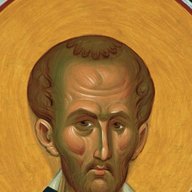
St. John ChrysostomHomily 1 on 1 Timothy · on 1 Timothy 1:1
Great and admirable is the dignity of an Apostle, and we find Paul constantly setting forth the causes of it, not as if he took the honor to himself, but as intrusted with it, and being under the necessity of so doing. For when he speaks of himself as "called," and that "by the will of God," and again elsewhere, "a…
St. John ChrysostomHomily 1 on 1 Timothy · on 1 Timothy 1:2
"Unto Timothy, my own son in the faith." This too is encouraging. For if he evinced such faith as to be called peculiarly Paul's "own" son, he might be confident also with respect to the future. For it is the part of faith not to be cast down or disturbed, though circumstances occur that seem contrary to the promises.…
St. John ChrysostomHomily 1 on 1 Timothy · on 1 Timothy 1:3
"As I besought thee to abide still at Ephesus, when I went into Macedonia." Observe the gentleness of the expression, more like that of a servant than of a master. For he does not say "I commanded," or "bade" or even "exhorted," but "I besought thee." But this tone is not for all: only meek and virtuous disciples are…
St. John ChrysostomHomily 1 on 1 Timothy · on 1 Timothy 1:4
"Neither give heed to fables and endless genealogies." By "fables" he does not mean the law; far from it; but inventions and forgeries and counterfeit doctrines. For, it seems, the Jews wasted their whole discourse on these unprofitable points. "That thou mightest charge some," he says, "that they teach no other…
St. John ChrysostomHomily 2 on 1 Timothy · on 1 Timothy 1:5
Nothing is so injurious to mankind as to undervalue friendship; and not to cultivate it with the greatest care; as nothing, on the other hand, is so beneficial, as to pursue it to the utmost of our power. This Christ has shown, where He says, "If two of you shall agree on earth, as touching anything that they shall…
St. John ChrysostomHomily 2 on 1 Timothy · on 1 Timothy 1:6
"From which some having swerved have turned aside to vain jangling." He has well said, "swerved," for it requires skill, to shoot straight and not beside the mark, to have the direction of the Spirit. For there are many things to turn us aside from the right course, and we should look but to one object.
St. John ChrysostomHomily 2 on 1 Timothy · on 1 Timothy 1:7
"Desiring to be teachers of the law." Here we see another cause of evil, the love of power. Wherefore Christ said, "Be not ye called Rabbi" (Matt. xxiii. 8); and the Apostle again, "For neither do they keep the law, but that they may glory in your flesh." (Gal. vi. 13.) They desire preeminence, he means, and on that…
St. John ChrysostomHomily 2 on 1 Timothy · on 1 Timothy 1:8
"But we know that the law is good, if a man use it lawfully. Knowing this, that the law is not made for a righteous man." The law, he seems to say, is good, and again, not good. What then? if one use it not lawfully, is it not good? Nay even so it is good. But what he means is this; if any one fulfills it in his…
Knowing this, that the law is not made for a righteous man, but for the lawless and disobedient, for the ungodly and for sinners, for unholy and profane, for murderers of fathers and murderers of mothers, for manslayers,
St. John ChrysostomHomily 2 on 1 Timothy · on 1 Timothy 1:9
"But for the lawless and disobedient, for the ungodly and for sinners, for the unholy and profane, for murderers of fathers and murderers of mothers." He calls the Jews "lawless and disobedient" too. "The law (he says) worketh wrath," that is, to the evil doers. But what to him who is deserving of reward? "By the law…
For whoremongers, for them that defile themselves with mankind, for menstealers, for liars, for perjured persons, and if there be any other thing that is contrary to sound doctrine;
St. John ChrysostomHomily 2 on 1 Timothy · on 1 Timothy 1:10
"For murderers of fathers and murderers of mothers, for manslayers, for whoremongers, for them that defile themselves with mankind, for menstealers, for liers, for perjured persons, and if there be any other thing that is contrary to sound doctrine." For all the things which he had mentioned were the passions of a…
St. John ChrysostomHomily 2 on 1 Timothy · on 1 Timothy 1:11
"According to the glorious Gospel of the blessed God, which was committed to my trust." Thus the Law is still necessary for the confirmation of the Gospel, yet to those who obey it is unnecessary. And he calls the Gospel "glorious." There were some who were ashamed of its persecutions, and of the sufferings of Christ,…
And I thank Christ Jesus our Lord, who hath enabled me, for that he counted me faithful, putting me into the ministry;
Καὶ χάριν ἔχω τῷ ἐνδυναμώσαντί με Χριστῷ Ἰησοῦ τῷ Κυρίῳ ἡμῶν, ὅτι πιστόν με ἡγήσατο, θέμενος εἰς διακονίαν
St. John ChrysostomHomily 3 on 1 Timothy · on 1 Timothy 1:12
The advantages arising from humility are generally acknowledged, and yet it is a thing not easily to be met with. There is affectation of humble talking enough and to spare, but humbleness of mind is nowhere to be found. This quality was so cultivated by the blessed Paul, that he is ever looking out for inducements to…
St. John ChrysostomHomily 3 on 1 Timothy · on 1 Timothy 1:12
And what is this, "Who enabled me"? I will tell you. He had so heavy a burden to sustain, that he needed much aid from above. For think what it was to be exposed to daily insults, and mockeries, and snares, and dangers, scoffs, and reproaches, and deaths; and not to faint, or slip, or turn backward, but though…
St. John ChrysostomHomily 3 on 1 Timothy · on 1 Timothy 1:12
"I thank the Lord, who hath enabled me." Observe how he thanks God even for that which was his own part. For he acknowledges it as a favor from Him that he was "a chosen vessel." For this, O blessed Paul, was thy own part. "For God is no respecter of persons." But I thank Him that he "thought me worthy of this…
St. John ChrysostomHomily 3 on 1 Timothy · on 1 Timothy 1:13
Then observe how he magnifies the mercy and loving-kindness of God, in describing his former life, "who was formerly," he says, "a blasphemer, and a persecutor, and injurious." And when he speaks of the still unbelieving Jews, he rather extenuates their guilt. "For I bear them record that they have a zeal for God, but…
St. John ChrysostomHomily 3 on 1 Timothy · on 1 Timothy 1:13
"But I obtained mercy because I did it ignorantly in unbelief." Why then did other Jews not obtain mercy? Because what they did, they did not ignorantly, but willfully, well knowing what they did. For this we have the testimony of the Evangelist. "Many of the Jews believed on Him, but because of the Pharisees they did…
St. John ChrysostomHomily 3 on 1 Timothy · on 1 Timothy 1:13
But where was Paul then? Perhaps one should say he was sitting at the feet of Gamaliel, and took no part with the multitude who conspired against Jesus: for Gamaliel does not appear to have been an ambitious man. Then how is it that afterwards Paul was found joining with the multitude? He saw the doctrine growing, and…
St. John ChrysostomHomily 3 on 1 Timothy · on 1 Timothy 1:13
But it is worthy of enquiry, how one so skillful in the law as Paul could be ignorant? For it is he who says, "which He had promised before by His holy prophets." (Rom. iv. 2.) How is it then that thou knowest not, thou who art zealous of the law of their fathers, who wert brought up at the feet of Gamaliel? Yet they…
St. John ChrysostomHomily 3 on 1 Timothy · on 1 Timothy 1:14
"And the grace of our Lord was exceeding abundant with faith and love which is in Christ Jesus." This is added, lest hearing that he obtained mercy, we should understand by it only, that being deserving of punishment, as a persecutor and blasphemer, nevertheless he was not punished. But mercy was not confined to this,…
St. John ChrysostomHomily 3 on 1 Timothy · on 1 Timothy 1:14
Having thus enlarged upon the love of God which, not content with showing mercy to a blasphemer and persecutor, conferred upon him other blessings in abundance, he has guarded against that error of the unbelievers which takes away free will, by adding, "with faith and love which is in Christ Jesus." Thus much only, he…
St. John ChrysostomHomily 4 on 1 Timothy · on 1 Timothy 1:15
The favors of God so far exceed human hope and expectation, that often they are not believed. For God has bestowed upon us such things as the mind of man never looked for, never thought of. It is for this reason that the Apostles spend much discourse in securing a belief of the gifts that are granted us of God. For as…
St. John ChrysostomHomily 4 on 1 Timothy · on 1 Timothy 1:15
"This is a faithful saying," he says. But why is it to be believed? This appears both from what precedes and from what follows. Observe how he prepares us for this assertion, and how he then dwells upon it. For he hath previously declared that He showed mercy to me "a blasphemer and a persecutor"; this was in the way…
St. John ChrysostomHomily 4 on 1 Timothy · on 1 Timothy 1:15
But how is it, that he here calls himself a sinner, nay, the chief of sinners, whereas he elsewhere asserts that he was "touching the righteousness which is in the law blameless"? Because with respect to the righteousness which God has wrought, the justification which is really sought, even those who are righteous in…
Howbeit for this cause I obtained mercy, that in me first Jesus Christ might shew forth all longsuffering, for a pattern to them which should hereafter believe on him to life everlasting.
St. John ChrysostomHomily 4 on 1 Timothy · on 1 Timothy 1:16
"Howbeit for this cause I obtained mercy, that in me first Jesus Christ might show forth all longsuffering, for a pattern to them which should hereafter believe on Him to life everlasting." See how he further humbles and depreciates himself, by naming a fresh and less creditable reason. For that he obtained mercy on…
St. John ChrysostomHomily 4 on 1 Timothy · on 1 Timothy 1:16
This will appear by an example. Suppose a populous city, all whose inhabitants were wicked, some more so, and some less, but all deserving of condemnation; and let one among that multitude be more deserving of punishment than all the rest, and guilty of every kind of wickedness. If it were declared that the king was…
St. John ChrysostomHomily 4 on 1 Timothy · on 1 Timothy 1:16
Therefore, he says, since I am saved, let no one doubt of salvation. And observe the humility of this blessed man; he says not, "that in me he might show forth" His "longsuffering," but "all longsuffering"; as if he had said, greater longsuffering He could not show in any case than in mine, nor find a sinner that so…
St. John ChrysostomHomily 4 on 1 Timothy · on 1 Timothy 1:17
"Now unto the King eternal, immortal, invisible, the only wise God, be honor and glory for ever and ever. Amen." For these things, then, we glorify not the Son only, but the Father. Here let us argue with the heretics. Speaking of the Father, he says, "To the only God." Is the Son then not God? "The only immortal." Is…
St. John ChrysostomHomily 4 on 1 Timothy · on 1 Timothy 1:17
Why then do you make the difference? Because the Father, he says, is made such as He is by no other: but the Son is what He is, from the Father. This we also confess, not denying that the Son is generated from the Father incorruptibly. And we glorify the Father, he means, for having generated the Son, such as He is.…
St. John ChrysostomHomily 4 on 1 Timothy · on 1 Timothy 1:17
It has been said of the Son, "By whom He made the worlds." Now there is a distinction observed among us between creation and workmanship. For one works and toils and executes, another rules; and why? because he that executes is the inferior. But it is not so there; nor is the sovereignty with One, the workmanship with…
St. John ChrysostomHomily 4 on 1 Timothy · on 1 Timothy 1:17
"To Him be honor and glory forever. Amen." Now honor and glory are not mere words; and since He has honored us not by words only, but by what He has done for us, so let us honor Him by works and deeds. Yet this honor touches us, while that reaches not Him, for He needs not the honor that comes from us, we do need that…
St. John ChrysostomHomily 5 on 1 Timothy · on 1 Timothy 1:18
The office of a Teacher and that of a Priest is of great dignity, and to bring forward one that is worthy requires a divine election. So it was of old, and so it is now, when we make a choice without human passion, not looking to any temporal consideration, swayed neither by friendship, nor enmity. For though we be…
St. John ChrysostomHomily 5 on 1 Timothy · on 1 Timothy 1:19
"Holding faith, and a good conscience." For he that would be a Teacher must first teach himself. For as he who has not first been a good soldier, will never be a general, so it is with the Teacher; wherefore he says elsewhere, "Lest when I have preached to others, I myself should be a cast-away." "Holding faith," he…
St. John ChrysostomHomily 5 on 1 Timothy · on 1 Timothy 1:20
They then who turn aside from the faith must suffer shipwreck; and this he shows by an example. "Of whom are Hymenaeus and Alexander." And from them he would instruct us. You see how even from those times there have been seducing Teachers, curious enquirers, and men holding off from the faith, and searching out by…
Every note is a real passage, quoted word for word from a published English translation, with its source. Nothing here is summarised or written by us. Some verses have many notes and some have none, because the Fathers wrote more on some passages than others.
St. John Chrysostom, Homilies on 1 Timothy, Nicene and Post-Nicene Fathers, series 1, vol. 13 (1888–1889).
Scripture: the King James Version (1611); the Greek (tap Ελ) is the 1904 Patriarchal text of the Ecumenical Patriarchate.
All of these translations are in the public domain. The passages were matched to their verses by the Historical Christian Commentaries project, which also hosts the full texts we link to. The Fathers are a treasury of the Church's mind, and they are best read alongside the life of the Church: if a passage raises a question, bring it to your priest.