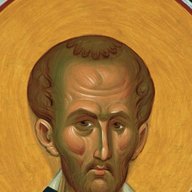
St. John ChrysostomHomily 12 on 2 Corinthians · on 2 Corinthians 6:1
For since he said, God beseeches, and we are ambassadors and suppliants unto you, that ye be "reconciled unto God:" lest they should become supine, he hereby again alarms and arouses them, saying: "We intreat that ye receive not the grace of God in vain." 'For let us not,' he says, 'therefore be at ease, because He…
St. John ChrysostomHomily 12 on 2 Corinthians · on 2 Corinthians 6:1
For lest they should think that this of itself is "reconciliation," believing on Him that calleth; he adds these words, requiting that earnestness which respects the life. For, for one who hath been freed from sins and made a friend to wallow in the former things, is to return again unto enmity, and to "receive the…
(For he saith, I have heard thee in a time accepted, and in the day of salvation have I succoured thee: behold, now is the accepted time; behold, now is the day of salvation.)
St. John ChrysostomHomily 12 on 2 Corinthians · on 2 Corinthians 6:2
"The acceptable time." What is this? That of the Gift, that of the Grace, when it is appointed not that an account should be required of our sins nor penalty exacted; but besides being delivered, that we should also enjoy ten thousand goods, righteousness, sanctification, and all the rest. For how much toil would it…
St. John ChrysostomHomily 12 on 2 Corinthians · on 2 Corinthians 6:2
Whilst then we are yet in the lists, whilst we are at work in the vineyard, whilst the eleventh hour is left [us], let us draw nigh and show forth life; for it is also easy. For he that striveth for the mastery at such a time, when so great a gift hath been shed forth, when so great grace, will early obtain the…
St. John ChrysostomHomily 12 on 2 Corinthians · on 2 Corinthians 6:3
"Giving no occasion of stumbling, that our ministration be not blamed." Persuading them not from considering "the time" only, but also those that had successfully labored with them. And behold with what absence of pride. For he said not, 'Look at us how we are such and such,' but, for the present, it is only to do…
St. John ChrysostomHomily 12 on 2 Corinthians · on 2 Corinthians 6:4
"But in every thing commending ourselves as ministers of God." This is far greater. For it is not the same thing to be free from accusation; and to exhibit such a character as in everything to appear "ministers of God." For neither is it the same thing to be quit of accusation, and to be covered with praises. And he…
St. John ChrysostomHomily 12 on 2 Corinthians · on 2 Corinthians 6:5
"In stripes, in imprisonments, in tossings to and fro." Yet every one of these by itself was intolerable, the being scourged only, and being bound only, and being unable through persecution to remain fixed any where, (for this is "in tossings to and fro,") but when both all, and all at once, assail, consider what a…
St. John ChrysostomHomily 12 on 2 Corinthians · on 2 Corinthians 6:6
"In knowledge." What is "in knowledge?" In wisdom such as is given from God; that which is truly knowledge; not as those that seem to be wise and boast of their acquaintance with the heathen discipline, but are deficient in this. "In long-suffering, in kindness" For this also is a great note of a noble soul, though…
St. John ChrysostomHomily 12 on 2 Corinthians · on 2 Corinthians 6:7
"In the word of truth." A thing he says in many places, that 'we continued neither to handle the word of God deceitfully nor to adulterate it.' "In the power of God." That which he always does ascribing nothing to himself but the whole to God, and imputing whatsoever he hath done aright to Him, this he hath done here…
St. John ChrysostomHomily 12 on 2 Corinthians · on 2 Corinthians 6:8
"By glory and dishonor, by evil report and good report." What sayest thou? That thou enjoyest honor, and setting down this as a great thing? 'Yes,' he saith. Why, forsooth? For to bear dishonor indeed is a great thing, but to partake of honor requires not a vigorous soul. Nay, it needs a vigorous and exceeding great…
St. John ChrysostomHomily 12 on 2 Corinthians · on 2 Corinthians 6:8
"By evil report and good report." For not only did he bear those things nobly which happen to the body, the 'afflictions, and whatever he enumerated, but those also which touch the soul; for neither are these wont to disturb slightly. Jeremiah at least having borne many temptations, gave in upon these, and when he was…
St. John ChrysostomHomily 12 on 2 Corinthians · on 2 Corinthians 6:9
"As unknown, and yet well known." This is, "by glory and dishonor." For by some they were well known and much sought after, whilst others designed not to know them at all. "As dying, and behold, we live." As under sentence of death and condemned; which was itself also matter of dishonor. But this he said, to show both…
St. John ChrysostomHomily 12 on 2 Corinthians · on 2 Corinthians 6:10
"As sorrowful, yet alway rejoicing." For by those that are without, indeed, we are suspected of being in despair; but we give no heed to them; yea, we have our pleasure at the full. And he said not "rejoicing" only, but added also its perpetuity, for he says, "alway rejoicing." What then can come up to this life?…
St. John ChrysostomHomily 12 on 2 Corinthians · on 2 Corinthians 6:10
"As having nothing, and yet possessing all things." And how can this be? Yea rather, how can the opposite be? For he that possesseth many things hath nothing; and he that hath nothing possesseth the goods of all. And not here only, but also in the other points, contraries were to have all things, let us bring forth…
St. John ChrysostomHomily 12 on 2 Corinthians · on 2 Corinthians 6:10
Now these things he says, to instruct us not to be disturbed at the opinions of the many, though they call us deceivers, though they know us not, though they count us condemned, and appointed unto death, to be in sorrow, to be in poverty, to have nothing, to be (us, who are in cheerfulness) desponding: because that…
St. John ChrysostomHomily 12 on 2 Corinthians · on 2 Corinthians 6:10
What then were the "all things" which Paul possessed, when he said, "As having nothing, and yet possessing all things?" Things temporal, things spiritual. For he whom the cities received as an angel, for whom they would have plucked out their own eyes and have given them to him, he for whom they laid down their own…
St. John ChrysostomHomily 13 on 2 Corinthians · on 2 Corinthians 6:11
"Our mouth is open unto you, O ye Corinthians." And what kind of sign of love is this? or what meaning even have the words at all? 'We cannot endured' he says, 'to be silent towards you, but are always desiring and longing to speak to and converse with you;' which is the wont of those who love. For what grasping of…
St. John ChrysostomHomily 13 on 2 Corinthians · on 2 Corinthians 6:12
"Ye are not straitened in us, but ye are straitened in your own affections." And this reproof, see it administered with forbearance, as is the wont of such as love exceedingly. He did not say, 'ye do not love us,' but, 'not in the same measure,' for he does not wish to touch them too sensibly. 'You receive one,' he…
St. John ChrysostomHomily 13 on 2 Corinthians · on 2 Corinthians 6:13
"Now for a recompense in like kind (I speak as unto my children,) be ye also enlarged." And yet it is not an equal return, first to be loved, afterwards to love. For even if one were to contribute that which is equal in amount, he is inferior in that he comes to it second. 'But nevertheless I am not going to reckon…
Be ye not unequally yoked together with unbelievers: for what fellowship hath righteousness with unrighteousness? and what communion hath light with darkness?
St. John ChrysostomHomily 13 on 2 Corinthians · on 2 Corinthians 6:14
"Be ye not unequally yoked together with unbelievers." He said not, 'Intermix not with unbelievers,' but rather dealing sharply with them, as transgressing what was right, 'Suffer not yourselves to turn aside,' saith he, "For what fellowship have righteousness and iniquity?" Here in what follows he institutes a…
St. John ChrysostomHomily 13 on 2 Corinthians · on 2 Corinthians 6:15
"And what communion hath light with darkness? And what concord hath Christ with Beliar? Or what portion hath a believer with an unbeliever?" Seest thou how he uses the bare names, and how adequately to his purpose of dissuasion. For he did not say, 'neglect of righteousness,' [but] what was stronger [iniquity]; nor…
And what agreement hath the temple of God with idols? for ye are the temple of the living God; as God hath said, I will dwell in them, and walk in them; and I will be their God, and they shall be my people.
St. John ChrysostomHomily 13 on 2 Corinthians · on 2 Corinthians 6:16
"What agreement hath a temple of God with idols? For ye are a temple of the living God." Now what he says is this. Neither hath your King aught in common with him, "for what concord hath Christ with Beliar?" nor have the things [aught in common'], "for what communion hath light with darkness?" Therefore neither should…
St. John ChrysostomHomily 13 on 2 Corinthians · on 2 Corinthians 6:17
"Wherefore come ye out from among them, and be ye separate, and touch no unclean thing; and I will receive you, saith the Lord." And He said not, 'Do not unclean things'; but, requiring greater strictness, 'do not even touch,' saith he, 'nor go near them.' But what is filthiness of the flesh? Adultery, fornication,…
St. John ChrysostomHomily 13 on 2 Corinthians · on 2 Corinthians 6:18
"And I will be to you a Father, and ye shall be to me sons and daughters, saith the Lord." Seest thou how from the beginning the Prophet fore-announceth our present high birth, the Regeneration by grace?
Every note is a real passage, quoted word for word from a published English translation, with its source. Nothing here is summarised or written by us. Some verses have many notes and some have none, because the Fathers wrote more on some passages than others.
St. John Chrysostom, Homilies on 2 Corinthians, Nicene and Post-Nicene Fathers, series 1, vol. 12 (1888–1889).
Scripture: the King James Version (1611); the Greek (tap Ελ) is the 1904 Patriarchal text of the Ecumenical Patriarchate.
All of these translations are in the public domain. The passages were matched to their verses by the Historical Christian Commentaries project, which also hosts the full texts we link to. The Fathers are a treasury of the Church's mind, and they are best read alongside the life of the Church: if a passage raises a question, bring it to your priest.