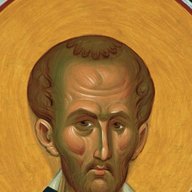
St. John ChrysostomHomily 4 on 2 Timothy · on 2 Timothy 2:1
The young sailor at sea is inspired with great confidence, if the Master of the ship has been preserved in a shipwreck. For he will not consider that it is from his inexperience that he is exposed to the storm, but from the nature of things; and this has no little effect upon his mind. In war also the Captain, who…
St. John ChrysostomHomily 4 on 2 Timothy · on 2 Timothy 2:2
"And the things that thou hast heard of me among many witnesses, the same commit thou to faithful men"; to "faithful" men, not to questioners nor to reasoners, to "faithful." How faithful? Such as betray not the Gospel they should preach. "The things which thou hast heard," not which thou hast searched out. For "faith…
St. John ChrysostomHomily 4 on 2 Timothy · on 2 Timothy 2:3
"Thou therefore endure hardness as a good soldier of Jesus Christ." Oh, how great a dignity is this, to be a soldier of Jesus Christ! Observe the kings on earth, how great an honor it is esteemed to serve under them. If therefore the soldier of the king ought to endure hardness, not to endure hardness is not the part…
St. John ChrysostomHomily 4 on 2 Timothy · on 2 Timothy 2:4
"No man that warreth entangleth himself with the affairs of this life, that he may please him who hath chosen him to be a soldier. And if a man also strive for masteries, yet is he not crowned except he strive lawfully." These things are said indeed to Timothy, but through him they are addressed to every teacher and…
St. John ChrysostomHomily 4 on 2 Timothy · on 2 Timothy 2:5
"And if a man also strive for masteries, yet is he not crowned except he strive lawfully." These things are said indeed to Timothy, but through him they are addressed to every teacher and disciple. Let no one therefore of those who hold the office of a Bishop disdain to hear these things, but let him be ashamed not to…
St. John ChrysostomHomily 4 on 2 Timothy · on 2 Timothy 2:6
"The husbandman that laboreth must be first partaker of the fruits." He had first spoken from his own example as a teacher. He now speaks from those that are more common, as wrestlers and soldiers, and in their case he sets before him the rewards. First, that he may please him who hath chosen him to be a soldier;…
St. John ChrysostomHomily 4 on 2 Timothy · on 2 Timothy 2:7
"Consider what I say, and the Lord give thee understanding in all things." It is on this account that he has spoken these things in proverb and parable. Then again to show his affectionate disposition, he ceases not to pray for him, as fearing for his own son...
St. John ChrysostomHomily 4 on 2 Timothy · on 2 Timothy 2:8
"Remember that Jesus Christ, of the seed of David, was raised from the dead, according to my Gospel. Wherein I suffer trouble as an evil-doer, even unto bonds." On what account is this mentioned? It is directed chiefly against the heretics, at the same time to encourage Timothy, by showing the advantage of sufferings,…
St. John ChrysostomHomily 4 on 2 Timothy · on 2 Timothy 2:9
"Wherein I suffer trouble," he says, "as an evil-doer, even unto bonds." Again he introduces consolation and encouragement from himself, and he prepares his hearer's mind with these two things; first, that he should know him to endure hardness; and, secondly, that he did not so but for a useful purpose, for in this…
St. John ChrysostomHomily 4 on 2 Timothy · on 2 Timothy 2:10
"Therefore I endure all things," he says, "for the elect's sake, that they may also obtain the salvation which is in Christ Jesus with eternal glory." Behold another incentive. I endure these things, he says, not for myself, but for the salvation of others. It was in my power to have lived free from danger; to have…
St. John ChrysostomHomily 5 on 2 Timothy · on 2 Timothy 2:11
Many of the weaker sort of men give up the effort of faith, and do not endure the deferring of their hope. They seek things present, and form from these their judgment of the future. When therefore their lot here was death, torments, and chains, and yet he says, they shall come to eternal life, they would not have…
St. John ChrysostomHomily 5 on 2 Timothy · on 2 Timothy 2:12
"If we suffer, we shall also reign with Him," not absolutely, we shall reign, but "if we suffer," showing that it is not enough to die once, (the blessed man himself died daily,) but there was need of much patient endurance; and especially Timothy had need of it. For tell me not, he says, of your first sufferings, but…
St. John ChrysostomHomily 5 on 2 Timothy · on 2 Timothy 2:13
And to show this, he has added, "If we believe not, He abideth faithful: He cannot deny Himself": that is, if we believe not that He rose again, He is not injured by it. He is faithful and unshaken, whether we say so or not. If then He is not at all injured by our denying Him, it is for nothing else than for our…
Of these things put them in remembrance, charging them before the Lord that they strive not about words to no profit, but to the subverting of the hearers.
St. John ChrysostomHomily 5 on 2 Timothy · on 2 Timothy 2:14
"Of these things put them in remembrance, charging them before the Lord, that they strive not about words to no profit, but to the subverting of the hearers." It is an overawing thing to call God to witness what we say, for if no one would dare to set at nought the testimony of man when appealed to, much less when the…
St. John ChrysostomHomily 5 on 2 Timothy · on 2 Timothy 2:15
"Study to show thyself approved unto God, a workman that needeth not to be ashamed, rightly dividing the word of truth." Everywhere this "not being ashamed"! And why is he ever so careful to guard him against shame? Because it was natural for many to be ashamed both of Paul himself, as being a tent-maker, and of the…
St. John ChrysostomHomily 5 on 2 Timothy · on 2 Timothy 2:16–17
"And shun profane novelties of speech." For they will not stop there. For when anything new has been introduced, it is ever producing innovations, and the error of him who has once left the safe harbor is infinite, and never stops. "For they will increase unto more ungodliness," he says, "And their word will eat as…
St. John ChrysostomHomily 5 on 2 Timothy · on 2 Timothy 2:18
"Of whom is Hymeneus and Philetus, Who concerning the truth have erred, saying that the resurrection is past already, and overthrow the faith of some." He has well said, "They will increase unto more ungodliness." For it appears indeed to be a solitary evil, but see what evils spring out of it. For if the Resurrection…
Nevertheless the foundation of God standeth sure, having this seal, The Lord knoweth them that are his. And, Let every one that nameth the name of Christ depart from iniquity.
St. John ChrysostomHomily 5 on 2 Timothy · on 2 Timothy 2:19
"Nevertheless," he says, "the foundation of God standeth sure, having this seal, The Lord knoweth them that are His. And, Let every one that nameth the name of the Lord depart from iniquity." He shows that even before they were subverted, they were not firm. For otherwise, they would not have been overthrown at the…
St. John ChrysostomHomily 6 on 2 Timothy · on 2 Timothy 2:20–21
Many men are still even now perplexed to account for the fact, that the wicked are suffered to remain, and are not yet destroyed. Now doubtless various reasons may be assigned for this, as, that they may be converted, or that by their punishment they may be made an example to the multitude. But Paul here mentions a…
If a man therefore purge himself from these, he shall be a vessel unto honour, sanctified, and meet for the master’s use, and prepared unto every good work.
St. John ChrysostomHomily 6 on 2 Timothy · on 2 Timothy 2:22
"Flee also youthful lusts." Not only the lust of fornication, but every inordinate desire is a youthful lust. Let the aged learn that they ought not to do the deeds of the youthful. If one be given to insolence, or a lover of power, of riches, of bodily pleasures, it is a youthful lust, and foolish. These things must…
St. John ChrysostomHomily 6 on 2 Timothy · on 2 Timothy 2:23
"But foolish and unlearned questions avoid, knowing that they do gender strifes." Do you see how he everywhere draws him off from questions; not that he was not able to overthrow them; for he was well able. For had he not been able he would have said, Be diligent, that thou mayest be able to refute them; as when he…
St. John ChrysostomHomily 6 on 2 Timothy · on 2 Timothy 2:24
"And the servant of the Lord must not strive." Not even in questions ought he to strive, for the servant of the Lord must keep far from strife, since God is the God of peace, and what should the servant of the God of peace have to do with strife? "But be gentle unto all men." How is it then he says, "Rebuke with all…
St. John ChrysostomHomily 6 on 2 Timothy · on 2 Timothy 2:25
"In meekness instructing those that oppose themselves." For he that teaches must be especially careful to do it with meekness. For a soul that wishes to learn cannot gain any useful instruction from harshness and contention. For when it would apply, being thus thrown into perplexity, it will learn nothing. He who…
St. John ChrysostomHomily 6 on 2 Timothy · on 2 Timothy 2:26
"And that they may recover themselves out of the snare of the devil, who are taken captive by him at his will." It is truly said, "Who are taken captive," for meanwhile they float in error. Observe here how he teaches to be humble-minded. He has not said, if peradventure you should be able, but, "if peradventure God…
Every note is a real passage, quoted word for word from a published English translation, with its source. Nothing here is summarised or written by us. Some verses have many notes and some have none, because the Fathers wrote more on some passages than others.
St. John Chrysostom, Homilies on 2 Timothy, Nicene and Post-Nicene Fathers, series 1, vol. 13 (1888–1889).
Scripture: the King James Version (1611); the Greek (tap Ελ) is the 1904 Patriarchal text of the Ecumenical Patriarchate.
All of these translations are in the public domain. The passages were matched to their verses by the Historical Christian Commentaries project, which also hosts the full texts we link to. The Fathers are a treasury of the Church's mind, and they are best read alongside the life of the Church: if a passage raises a question, bring it to your priest.