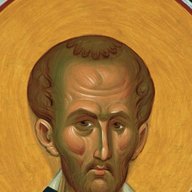
St. John ChrysostomHomily 51 on Acts · on Acts 25:1–3
This man is succeeded in his office by another, and he leaves Paul a prisoner: and yet he ought not to have done this; he ought to have put an end to the business: but he leaves him, by way of gratifying them. They however were so urgent, that they again besought the judge. Yet against none of the Apostles had they…
St. John ChrysostomHomily 51 on Acts · on Acts 25:1–3
"Now when Festus was come into the province," etc. At the very beginning, the priests came to him, who would not have hesitated to go even to Caesarea, unless he had been seen immediately coming up, since immediately on his arrival they come to him. And he spends ten days, in order, I suppose, to be open to those who…
St. John ChrysostomHomily 51 on Acts · on Acts 25:4–6
What are ye afraid of? What are ye in such a hurry? In fact, that expression, "that he should be kept" shows this. Does he want to escape? "Let them therefore," he says, "which among you are able, accuse him." Again accusers, again at Caesarea, again Paul is brought forth. And having come, immediately "he sat on the…
And when he had tarried among them more than ten days, he went down unto Caesarea; and the next day sitting on the judgment seat commanded Paul to be brought.
And when he was come, the Jews which came down from Jerusalem stood round about, and laid many and grievous complaints against Paul, which they could not prove.
St. John ChrysostomHomily 51 on Acts · on Acts 25:7–8
But after they came down, they forthwith made their accusations shamelessly and with more vehemence: and not having been able to convict him on grounds relating to the Law, they again according to their custom stirred the question about Caesar, being just what they did in Christ's case. For that they had recourse to…
While he answered for himself, Neither against the law of the Jews, neither against the temple, nor yet against Caesar, have I offended any thing at all.
St. John ChrysostomHomily 51 on Acts · on Acts 25:9
While as yet he had not got acquainted with the Jews, nor experienced the honor paid to him by them, he answered rightly: but now that he had been in Jerusalem ten days, he too wants to pleasure them by sacrificing Paul to them: then, also to receive Paul, "Wilt thou," says he, "be judged there of these things by me?"…
St. John ChrysostomHomily 51 on Acts · on Acts 25:10–11
Some one might say, How is it, that having been told, "Thou must also bear witness of Me in Rome", he, as if unbelieving, did this? God forbid: nay, he did it, because he so strongly believed. For it would have been a tempting of God to be bold on account of that declaration, and to cast himself into numberless…
St. John ChrysostomHomily 51 on Acts · on Acts 25:10–11
"But Paul said, At Caesar's tribunal am I standing," etc.: he did not say, I will not, lest he should make the judge more vehement, but here again is his great boldness: They cast me out once for all, themselves, and by this they think to condemn me, by their showing that I have offended against Caesar: at his bar I…
For if I be an offender, or have committed any thing worthy of death, I refuse not to die: but if there be none of these things whereof these accuse me, no man may deliver me unto them. I appeal unto Caesar.
St. John ChrysostomHomily 51 on Acts · on Acts 25:12–13
"Then Festus, when he had conferred with the council" - do you observe how he seeks to gratify them? for this is favor - "having conferred," it says, "with the council, he said, Hast thou appealed unto Caesar? unto Caesar shall thou go." See how his trial is again lengthened out, and how the plot against him becomes…
St. John ChrysostomHomily 51 on Acts · on Acts 25:12–13
But this king Agrippa, who was also a Herod, was a different Agrippa, after him of James' time, so that this is the fourth Herod. See how his enemies cooperate with him against their will. To make the audience large, Agrippa falls into a desire of hearing: and he does not simply hear, but with much parade.
To whom I answered, It is not the manner of the Romans to deliver any man to die, before that he which is accused have the accusers face to face, and have licence to answer for himself concerning the crime laid against him.
St. John ChrysostomHomily 51 on Acts · on Acts 25:18
And see what a vindication! So writes Festus, and the ruthlessness of the Jews is openly made a show of: for when it is the governor that says these things, he is a witness above all suspicion: so that the Jews are condemned by him also. For, when all had pronounced sentence against them, then, and not sooner, God…
St. John ChrysostomHomily 51 on Acts · on Acts 25:20
"And not knowing, for my part, what to make of the enquiry concerning these things" - of course, it went beyond a judge's hearing, the examining into these matters. If thou art at a loss, why dost thou drag him to Jerusalem? But the other would not deign this: no, "To Caesar" says he; as in fact it was touching Caesar…
And on the morrow, when Agrippa was come, and Bernice, with great pomp, and was entered into the place of hearing, with the chief captains, and principal men of the city, at Festus’ commandment Paul was brought forth.
St. John ChrysostomHomily 52 on Acts · on Acts 25:23
See what an audience is gathered together for Paul. Having collected all his guards, the governor is come, and the king, and the tribunes, "with the principal men," it says, "of the city." Then Paul being brought forth, see how he is proclaimed as conqueror.
St. John ChrysostomHomily 52 on Acts · on Acts 25:23
The Jews desisted ever since Paul exercised his right of appeal. Then also for him the theatre becomes a splendid one: "with great pomp" they were present.
And Festus said, King Agrippa, and all men which are here present with us, ye see this man, about whom all the multitude of the Jews have dealt with me, both at Jerusalem, and also here, crying that he ought not to live any longer.
St. John ChrysostomHomily 52 on Acts · on Acts 25:24–27
Festus himself acquits him from the charges, for what says Festus? "And Festus said, King Agrippa, and all men which are here present with us, ye see this man, about whom all the multitude of the Jews have dealt with me, both at Jerusalem, and also here, crying that he ought not to live any longer. But when I found…
St. John ChrysostomHomily 52 on Acts · on Acts 25:24–27
"The whole multitude of the Jews-" not some of them only, and others not so-"both at Jerusalem, and also here," they said "that he ought not to live any longer." "And I having found," etc. It shows that he did right in appealing to Caesar. For if though they had no great matter to allege against him, yet those at…
Of whom I have no certain thing to write unto my lord. Wherefore I have brought him forth before you, and specially before thee, O king Agrippa, that, after examination had, I might have somewhat to write.
Every note is a real passage, quoted word for word from a published English translation, with its source. Nothing here is summarised or written by us. Some verses have many notes and some have none, because the Fathers wrote more on some passages than others.
St. John Chrysostom, Homilies on Acts, Nicene and Post-Nicene Fathers, series 1, vol. 11 (1888–1889).
Scripture: the King James Version (1611); the Greek (tap Ελ) is the 1904 Patriarchal text of the Ecumenical Patriarchate.
All of these translations are in the public domain. The passages were matched to their verses by the Historical Christian Commentaries project, which also hosts the full texts we link to. The Fathers are a treasury of the Church's mind, and they are best read alongside the life of the Church: if a passage raises a question, bring it to your priest.