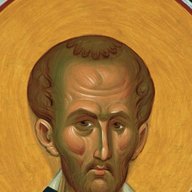
St. John ChrysostomHomily 53 on Acts · on Acts 27:1–2
See how far Aristarchus also accompanies Paul. To good and useful purpose is Aristarchus present, as he would take back the report of all to Macedonia.
The Eastern Cross/Bible/Acts/Chapter 27
The Acts of the Apostles
Tap Fathers under a verse to read what the saints said about it.
And when it was determined that we should sail into Italy, they delivered Paul and certain other prisoners unto one named Julius, a centurion of Augustus’ band.
Ὡς δὲ ἐκρίθη τοῦ ἀποπλεῖν ἡμᾶς εἰς τὴν Ἰταλίαν, παρεδίδουν τόν τε Παῦλον καί τινας ἑτέρους δεσμώτας ἑκατοντάρχῃ ὀνόματι Ἰουλίῳ σπείρης Σεβαστῆς.
See how far Aristarchus also accompanies Paul. To good and useful purpose is Aristarchus present, as he would take back the report of all to Macedonia.
And entering into a ship of Adramyttium, we launched, meaning to sail by the coasts of Asia; one Aristarchus, a Macedonian of Thessalonica, being with us.
ἐπιβάντες δὲ πλοίῳ Ἀδραμυττηνῷ μέλλοντες πλεῖν τοὺς κατὰ τὴν Ἀσίαν τόπους ἀνήχθημεν, ὄντος σὺν ἡμῖν Ἀριστάρχου Μακεδόνος Θεσσαλονικέως,
And the next day we touched at Sidon. And Julius courteously entreated Paul, and gave him liberty to go unto his friends to refresh himself.
τῇ τε ἑτέρᾳ κατήχθημεν εἰς Σιδῶνα· φιλανθρώπως τε ὁ Ἰούλιος τῷ Παύλῳ χρησάμενος ἐπέτρεψε πρὸς [τοὺς] φίλους πορευθέντα ἐπιμελείας τυχεῖν.
"And Julius courteously entreated Paul, and gave him liberty to go unto his friends to refresh himself. Julius gave Paul liberty," it says, acting "courteously, that he might refresh himself;" as it was but natural that he should be much the worse from his bonds and the fear, and the being dragged hither and thither.…
And when we had launched from thence, we sailed under Cyprus, because the winds were contrary.
κἀκεῖθεν ἀναχθέντες ὑπεπλεύσαμεν τὴν Κύπρον διὰ τὸ τοὺς ἀνέμους εἶναι ἐναντίους,
Again trials, again contrary winds. See how the life of the saints is thus interwoven throughout: escaped from the court of justice, they fall in with shipwreck and storm.
And when we had sailed over the sea of Cilicia and Pamphylia, we came to Myra, a city of Lycia.
τό τε πέλαγος τὸ κατὰ τὴν Κιλικίαν καὶ Παμφυλίαν διαπλεύσαντες κατήλθομεν εἰς Μύρα τῆς Λυκίας.
See how God does not innovate or change the order of nature, but suffers them to sail into the unfavorable winds. But even so the miracle is wrought. That they may sail safely, He did not let them go out in the open sea, but they always sailed near the land.
And there the centurion found a ship of Alexandria sailing into Italy; and he put us therein.
Κἀκεῖ εὑρὼν ὁ ἑκατοντάρχης πλοῖον Ἀλεξανδρῖνον πλέον εἰς τὴν Ἰταλίαν ἐνεβίβασεν ἡμᾶς εἰς αὐτό.
"A ship of Alexandria," it says. It is likely that both those in the former ship would bear to Asia the report of what had befallen Paul, and that these would do the same in Lycia. See how God does not innovate or change the order of nature, but suffers them to sail into the unfavorable winds. But even so the miracle…
And when we had sailed slowly many days, and scarce were come over against Cnidus, the wind not suffering us, we sailed under Crete, over against Salmone;
ἐν ἱκαναῖς δὲ ἡμέραις βραδυπλοοῦντες καὶ μόλις γενόμενοι κατὰ τὴν Κνίδον, μὴ προσεῶντος ἡμᾶς τοῦ ἀνέμου, ὑπεπλεύσαμεν τὴν Κρήτην κατὰ Σαλμώνην,
And, hardly passing it, came unto a place which is called The fair havens; nigh whereunto was the city of Lasea.
μόλις τε παραλεγόμενοι αὐτὴν ἤλθομεν εἰς τόπον τινὰ καλούμενον Καλοὺς λιμένας, ᾧ ἐγγὺς ἦν πόλις Λασαία.
Now when much time was spent, and when sailing was now dangerous, because the fast was now already past, Paul admonished them,
Ἱκανοῦ δὲ χρόνου διαγενομένου καὶ ὄντος ἤδη ἐπισφαλοῦς τοῦ πλοὸς διὰ τὸ καὶ τὴν νηστείαν ἤδη παρεληλυθέναι, παρῄνει ὁ Παῦλος
By "the fast" here, I suppose he means that of the Jews. For they departed thence a long time after the Pentecost, so that it was much about midwinter that they arrived at the coasts of Crete. And this too was no slight miracle, that they also should be saved on his account.
And said unto them, Sirs, I perceive that this voyage will be with hurt and much damage, not only of the lading and ship, but also of our lives.
λέγων αὐτοῖς· ἄνδρες, θεωρῶ ὅτι μετὰ ὕβρεως καὶ πολλῆς ζημίας οὐ μόνον τοῦ φόρτου καὶ τοῦ πλοίου, ἀλλὰ καὶ τῶν ψυχῶν ἡμῶν μέλλειν ἔσεσθαι τὸν πλοῦν.
And observe how unassuming the expression is. That he may not seem to prophesy, but to speak as of conjecture, "I perceive," says he. For they would not have received it, had he said this at the outset. In fact he does prophesy on this former occasion, as he does afterward, and says there, "The God whom I serve,"…
Nevertheless the centurion believed the master and the owner of the ship, more than those things which were spoken by Paul.
ὁ δὲ ἑκατοντάρχης τῷ κυβερνήτῃ καὶ τῷ ναυκλήρῳ ἐπείθετο μᾶλλον ἢ τοῖς ὑπὸ τοῦ Παύλου λεγομένοις.
Then, to show that it was not from conjecture that he so spake, the master of the ship said the contrary, and he a man of experience in the matter: so far was it from being the case that Paul's advice was given from conjecture. Moreover, the place suggested this same which the master said, "being not commodious;" and…
And because the haven was not commodious to winter in, the more part advised to depart thence also, if by any means they might attain to Phenice, and there to winter; which is an haven of Crete, and lieth toward the south west and north west.
ἀνευθέτου δὲ τοῦ λιμένος ὑπάρχοντος πρὸς παραχειμασίαν οἱ πλείους ἔθεντο βουλὴν ἀναχθῆναι κἀκεῖθεν, εἴ πως δύναιντο καταντήσαντες εἰς Φοίνικα παραχειμάσαι, λιμένα τῆς Κρήτης βλέποντα κατὰ λίβα καὶ κατὰ χῶρον.
And when the south wind blew softly, supposing that they had obtained their purpose, loosing thence, they sailed close by Crete.
Ὑποπνεύσαντος δὲ νότου δόξαντες τῆς προθέσεως κεκρατηκέναι, ἄραντες ἆσσον παρελέγοντο τὴν Κρήτην.
Mark then the providential ordering of the events: first indeed, "when the south wind blew softly, supposing they had obtained their purpose," they loosed the vessel, and came forth; then when the wind bore down upon them, they gave way to it driving them, and were with difficulty saved.
But not long after there arose against it a tempestuous wind, called Euroclydon.
μετ᾽ οὐ πολὺ δὲ ἔβαλε κατ᾽ αὐτῆς ἄνεμος τυφωνικὸς ὁ καλούμενος Εὐροκλύδων.
And when the ship was caught, and could not bear up into the wind, we let her drive.
συναρπασθέντος δὲ τοῦ πλοίου καὶ μὴ δυναμένου ἀντοφθαλμεῖν τῷ ἀνέμῳ ἐπιδόντες ἐφερόμεθα.
And running under a certain island which is called Clauda, we had much work to come by the boat:
νησίον δέ τι ὑποδραμόντες καλούμενον Κλαύδην μόλις ἰσχύσαμεν περικρατεῖς γενέσθαι τῆς σκάφης,
Which when they had taken up, they used helps, undergirding the ship; and, fearing lest they should fall into the quicksands, strake sail, and so were driven.
ἣν ἄραντες βοηθείαις ἐχρῶντο ὑποζωννύντες τὸ πλοῖον· φοβούμενοί τε μὴ εἰς τὴν Σύρτιν ἐκπέσωσι, χαλάσαντες τὸ σκεῦος οὕτως ἐφέροντο.
And we being exceedingly tossed with a tempest, the next day they lightened the ship;
σφοδρῶς δὲ χειμαζομένων ἡμῶν τῇ ἑξῆς ἐκβολὴν ἐποιοῦντο,
Then, severe the storm, deep the darkness: and that they may not forget, the vessel also goes to pieces, and the corn is flung out and all beside, that they may not have it in their power after this to be shameless. For this is why the vessel goes to pieces, and their souls are tightly braced. Moreover, both the storm…
And the third day we cast out with our own hands the tackling of the ship.
καὶ τῇ τρίτῃ αὐτόχειρες τὴν σκευὴν τοῦ πλοίου ἐρρίψαμεν.
And when neither sun nor stars in many days appeared, and no small tempest lay on us, all hope that we should be saved was then taken away.
μήτε δὲ ἡλίου μήτε ἄστρων ἐπιφαινόντων ἐπὶ πλείονας ἡμέρας, χειμῶνός τε οὐκ ὀλίγου ἐπικειμένου, λοιπὸν περιῃρεῖτο πᾶσα ἐλπὶς τοῦ σῴζεσθαι ἡμᾶς.
But after long abstinence Paul stood forth in the midst of them, and said, Sirs, ye should have hearkened unto me, and not have loosed from Crete, and to have gained this harm and loss.
Πολλῆς δὲ ἀσιτίας ὑπαρχούσης τότε σταθεὶς ὁ Παῦλος ἐν μέσῳ αὐτῶν εἶπεν· ἔδει μέν, ὦ ἄνδρες, πειθαρχήσαντάς μοι μὴ ἀνάγεσθαι ἀπὸ τῆς Κρήτης κερδῆσαί τε τὴν ὕβριν ταύτην καὶ τὴν ζημίαν.
Then after so great a storm he does not speak as insultingly over them, but as wishing that at any rate he might be believed for the future. Wherefore also he alleges what had taken place for a testimony of the truth of what was about to be said by him. One is not likely to have a good reception, when he chides in the…
And now I exhort you to be of good cheer: for there shall be no loss of any man’s life among you, but of the ship.
καὶ τὰ νῦν παραινῶ ὑμᾶς εὐθυμεῖν· ἀποβολὴ γὰρ ψυχῆς οὐδεμία ἔσται ἐξ ὑμῶν πλὴν τοῦ πλοίου.
And he foretells two things; both that they must be cast upon an island, and that though the ship would be lost, those who were in it should be saved - which thing he spoke not of conjecture, but of prophecy - and that he "must be brought before Caesar." But this that he says, "God hath given thee all," is not spoken…
For there stood by me this night the angel of God, whose I am, and whom I serve,
παρέστη γάρ μοι τῇ νυκτὶ ταύτῃ ἄγγελος τοῦ Θεοῦ οὗ εἰμι, ᾧ καὶ λατρεύω,
"For there stood by me this night the angel of God, whose I am, and whom I serve, saying, Fear not, Paul; thou must be brought before Caesar: and, lo God hath given thee all them that sail with thee." So that righteous men, though they may be in a tempest, or on the sea, or in the deep, suffer nothing dreadful, but…
Saying, Fear not, Paul; thou must be brought before Caesar: and, lo, God hath given thee all them that sail with thee.
λέγων· μὴ φοβοῦ, Παῦλε· Καίσαρί σε δεῖ παραστῆναι· καὶ ἰδοὺ κεχάρισταί σοι ὁ Θεὸς πάντας τοὺς πλέοντας μετὰ σοῦ.
Then after so great a storm he does not speak as insultingly over them, but as wishing that at any rate he might be believed for the future. Wherefore also he alleges what had taken place for a testimony of the truth of what was about to be said by him. ...And he foretells two things; both that they must be cast upon…
But this that he says, "God hath given thee all," is not spoken boastfully, but in the wish to win those who were sailing in the ship: for he spoke thus, not that they might feel themselves bound to him, but that they might believe what he was saying. "God hath given thee;" as much as to say, They are worthy indeed of…
Wherefore, sirs, be of good cheer: for I believe God, that it shall be even as it was told me.
διὸ εὐθυμεῖτε, ἄνδρες· πιστεύω γὰρ τῷ Θεῷ ὅτι οὕτως ἔσται καθ᾽ ὃν τρόπον λελάληταί μοι.
But when the fourteenth night was come, as we were driven up and down in Adria, about midnight the shipmen deemed that they drew near to some country;
Ὡς δὲ τεσσαρεσκαιδεκάτη νὺξ ἐγένετο διαφερομένων ἡμῶν ἐν τῷ Ἀδρίᾳ, κατὰ μέσον τῆς νυκτὸς ὑπενόουν οἱ ναῦται προσάγειν τινὰ αὐτοῖς χώραν.
And sounded, and found it twenty fathoms: and when they had gone a little further, they sounded again, and found it fifteen fathoms.
καὶ βολίσαντες εὗρον ὀργυιὰς εἴκοσι, βραχὺ δὲ διαστήσαντες καὶ πάλιν βολίσαντες εὗρον ὀργυιὰς δεκαπέντε·
Then fearing lest we should have fallen upon rocks, they cast four anchors out of the stern, and wished for the day.
φοβούμενοί τε μήπως εἰς τραχεῖς τόπους ἐκπέσωμεν, ἐκ πρύμνης ῥίψαντες ἀγκύρας τέσσαρας ηὔχοντο ἡμέραν γενέσθαι.
And as the shipmen were about to flee out of the ship, when they had let down the boat into the sea, under colour as though they would have cast anchors out of the foreship,
Τῶν δὲ ναυτῶν ζητούντων φυγεῖν ἐκ τοῦ πλοίου καὶ χαλασάντων τὴν σκάφην εἰς τὴν θάλασσαν, προφάσει ὡς ἐκ πρῴρας μελλόντων ἀγκύρας ἐκτείνειν,
The sailors however, were about to escape, having no faith in what was said: but the centurion does believe Paul. For he says, If these flee, "ye cannot be saved": so saying, not on this account, but that he might restrain them, and the prophecy might not fall to the ground. See how as in a church they are instructed…
Paul said to the centurion and to the soldiers, Except these abide in the ship, ye cannot be saved.
εἶπεν ὁ Παῦλος τῷ ἑκατοντάρχῃ καὶ τοῖς στρατιώταις· ἐὰν μὴ οὗτοι μείνωσιν ἐν τῷ πλοίῳ, ὑμεῖς σωθῆναι οὐ δύνασθε.
Paul said to the centurion and to the soldiers, "Except these abide in the ship, ye cannot be saved": so saying, not on this account, but that he might restrain them, and the prophecy might not fall to the ground. Accordingly observe how the centurion does as he bids him, insomuch that he even let the boat go, and…
Then the soldiers cut off the ropes of the boat, and let her fall off.
τότε οἱ στρατιῶται ἀπέκοψαν τὰ σχοινία τῆς σκάφης καὶ εἴασαν αὐτὴν ἐκπεσεῖν.
And while the day was coming on, Paul besought them all to take meat, saying, This day is the fourteenth day that ye have tarried and continued fasting, having taken nothing.
Ἄχρι δὲ οὗ ἔμελλεν ἡμέρα γίνεσθαι, παρεκάλει ὁ Παῦλος ἅπαντας μεταλαβεῖν τροφῆς λέγων· τεσσαρεσκαιδεκάτην σήμερον ἡμέραν προσδοκῶντες ἄσιτοι διατελεῖτε, μηδὲν προσλαβόμενοι.
And how, say you, did they go without food, having taken nothing? How did they bear it? Their fear possessed them, and did not let them fall into a desire of food, being, as they were, at the point of extreme jeopardy; but they had no care for food. Moreover, the place is a trying one, for it was in the Adriatic, and…
Wherefore I pray you to take some meat: for this is for your health: for there shall not an hair fall from the head of any of you.
διὸ παρακαλῶ ὑμᾶς μεταλαβεῖν τροφῆς· τοῦτο γὰρ πρὸς τῆς ὑμετέρας σωτηρίας ὑπάρχει· οὐδενὸς γὰρ ὑμῶν θρὶξ ἐκ τῆς κεφαλῆς πεσεῖται.
And when he had thus spoken, he took bread, and gave thanks to God in presence of them all: and when he had broken it, he began to eat.
εἰπὼν δὲ ταῦτα καὶ λαβὼν ἄρτον εὐχαρίστησε τῷ Θεῷ ἐνώπιον πάντων, καὶ κλάσας ἤρξατο ἐσθίειν.
And he exhorts them again to take some meat, and they do as he bids them, and he takes some first, to persuade them not by word, but also by act, that the storm did them no harm, but rather was a benefit to their souls. Observe, his giving thanks after all that had happened strengthened them. For this showed an…
Then were they all of good cheer, and they also took some meat.
εὔθυμοι δὲ γενόμενοι πάντες καὶ αὐτοὶ προσελάβοντο τροφῆς·
And we were in all in the ship two hundred threescore and sixteen souls.
ἦμεν δὲ ἐν τῷ πλοίῳ αἱ πᾶσαι ψυχαὶ διακόσιαι ἑβδομήκοντα ἕξ.
Two hundred and seventy-six souls: whence had they victuals? See how they do their part as men, and how Paul does not forbid them. They had thrown out the rest of the corn, but they trusted Paul's assurance for all.
And when they had eaten enough, they lightened the ship, and cast out the wheat into the sea.
κορεσθέντες δὲ τροφῆς ἐκούφιζον τὸ πλοῖον ἐκβαλλόμενοι τὸν σῖτον εἰς τὴν θάλασσαν.
And when it was day, they knew not the land: but they discovered a certain creek with a shore, into the which they were minded, if it were possible, to thrust in the ship.
Ὅτε δὲ ἡμέρα ἐγένετο, τὴν γῆν οὐκ ἐπεγίνωσκον, κόλπον δέ τινα κατενόουν ἔχοντα αἰγιαλόν, εἰς ὃν ἐβουλεύσαντο, εἰ δύναιντο, ἐξῶσαι τὸ πλοῖον.
And when they had taken up the anchors, they committed themselves unto the sea, and loosed the rudder bands, and hoised up the mainsail to the wind, and made toward shore.
καὶ τὰς ἀγκύρας περιελόντες εἴων εἰς τὴν θάλασσαν ἅμα ἀνέντες τὰς ζευκτηρίας τῶν πηδαλίων, καὶ ἐπάραντες τὸν ἀρτέμωνα τῇ πνεούσῃ κατεῖχον εἰς τὸν αἰγιαλόν.
"They made towards shore," having given the rudder-handles to the wind: for oftentimes they do it not in this way. They were borne along, having loosed the rigging, that is, the sails.
And falling into a place where two seas met, they ran the ship aground; and the forepart stuck fast, and remained unmoveable, but the hinder part was broken with the violence of the waves.
περιπεσόντες δὲ εἰς τόπον διθάλασσον ἐπώκειλαν τὴν ναῦν, καὶ ἡ μὲν πρῷρα ἐρείσασα ἔμεινεν ἀσάλευτος, ἡ δὲ πρύμνα ἐλύετο ὑπὸ τῆς βίας τῶν κυμάτων.
"And falling into a place where two seas met, they ran the ship aground; and the forepart stuck fast, and remained unmovable, but the hinder part was broken with the violence of the waves;" for when there is a strong wind, this is the consequence, the stern bearing the brunt of the storm.
And the soldiers’ counsel was to kill the prisoners, lest any of them should swim out, and escape.
τῶν δὲ στρατιωτῶν βουλὴ ἐγένετο ἵνα τοὺς δεσμώτας ἀποκτείνωσι, μή τις ἐκκολυμβήσας διαφύγοι.
Again the devil tries to hinder the prophecy, and they had a mind to kill some, but the centurion suffered them not, that he might save Paul, so much was the centurion attached to him.
But the centurion, willing to save Paul, kept them from their purpose; and commanded that they which could swim should cast themselves first into the sea, and get to land:
ὁ δὲ ἑκατοντάρχης βουλόμενος διασῶσαι τὸν Παῦλον ἐκώλυσεν αὐτοὺς τοῦ βουλήματος, ἐκέλευσέ τε τοὺς δυναμένους κολυμβᾶν ἀπορρίψαντας πρώτους ἐπὶ τὴν γῆν ἐξιέναι,
But the centurion, willing to save Paul, kept them from their purpose; and commanded that they which could swim should cast themselves first into the sea, and get to land: and the rest, some on boards, and some on broken pieces of the ship. And so it came to pass, that they escaped all safe to land.
And so it was through themselves being saved that they learnt who Paul was. But some one may say: why did he not save the ship? That they might perceive how great a danger they had escaped: and that the whole matter depended, not on the help of man, but on God's hand saving them independently of a ship.
And the rest, some on boards, and some on broken pieces of the ship. And so it came to pass, that they escaped all safe to land.
καὶ τοὺς λοιποὺς οὓς μὲν ἐπὶ σανίσιν, οὓς δὲ ἐπί τινων τῶν ἀπὸ τοῦ πλοίου. καὶ οὕτως ἐγένετο πάντας διασωθῆναι ἐπὶ τὴν γῆν.
So it came to pass, that they escaped all safe to land. Do you mark what good came of the storm? Why then it was no mark of their being forsaken, that the storm came upon them. Now this that happened was in consequence of the season of the year; but the wonder is greater, that at such a season they were saved from the…
Every note is a real passage, quoted word for word from a published English translation, with its source. Nothing here is summarised or written by us. Some verses have many notes and some have none, because the Fathers wrote more on some passages than others.
All of these translations are in the public domain. The passages were matched to their verses by the Historical Christian Commentaries project, which also hosts the full texts we link to. The Fathers are a treasury of the Church's mind, and they are best read alongside the life of the Church: if a passage raises a question, bring it to your priest.