Now of the things which we have spoken this is the sum: We have such an high priest, who is set on the right hand of the throne of the Majesty in the heavens;
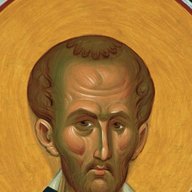
St. John ChrysostomHomily 14 on Hebrews · on Hebrews 8:1–2
Paul mixes the lowly things with the lofty, ever imitating his Master, so that the lowly become the path to the lofty, and through the former we are led to the latter, and when we are amid the great things we learn that these lowly ones were a condescension. This accordingly he does here also. After declaring that "He…
St. John ChrysostomHomily 14 on Hebrews · on Hebrews 8:3
In the next place that thou mayest understand that he used the word "minister" of the manhood, observe how he again indicates it: "For" (he says) "every high priest is ordained to offer both gifts and sacrifices, wherefore it is of necessity that this man have somewhat also to offer." Do not now, because thou hearest…
St. John ChrysostomHomily 14 on Hebrews · on Hebrews 8:4
And in another way; Having said that He is on high, he affirms and proves that He is a Priest from every consideration, from Melchisedec, from the oath, from offering sacrifice. From this he also frames another and necessary syllogism. "For if" (he says) "He had been on earth, He would not be a Priest, seeing that…
Who serve unto the example and shadow of heavenly things, as Moses was admonished of God when he was about to make the tabernacle: for, See, saith he, that thou make all things according to the pattern shewed to thee in the mount.
St. John ChrysostomHomily 14 on Hebrews · on Hebrews 8:5
Here we must apply our minds attentively, and consider the Apostolic wisdom; for again he shows the difference of the Priesthood. "Who" (he says) "serve unto the example and shadow of heavenly things." What are the heavenly things he speaks of here? The spiritual things. For although they are done on earth, yet…
But now hath he obtained a more excellent ministry, by how much also he is the mediator of a better covenant, which was established upon better promises.
St. John ChrysostomHomily 14 on Hebrews · on Hebrews 8:6
"But now hath He obtained a more excellent ministry, by how much also He is the Mediator of a better covenant." Thou seest (he means) how much better is the one ministration than the other, if one be an example and type, and the other truth. But this did not profit the hearers, nor cheer them. Therefore he says what…
St. John ChrysostomHomily 14 on Hebrews · on Hebrews 8:7
Whence does appear? In that this the one was cast out, and the other introduced in its place: for it is therefore of force because it is better. For as he says, "If perfection were by" it, "what further need was there, that another priest should rise, after the order of Melchisedec?" (Heb. vii. 11); so also here he…
For finding fault with them, he saith, Behold, the days come, saith the Lord, when I will make a new covenant with the house of Israel and with the house of Judah:
St. John ChrysostomHomily 14 on Hebrews · on Hebrews 8:8–9
"But finding fault with them, He saith, Behold, the days come, saith the Lord, when I will make a new covenant with the house of Israel and with the house of Judah: not according to the covenant that I made with their fathers in the day when I took them by the hand to lead them out of the land of Egypt: because they…
Not according to the covenant that I made with their fathers in the day when I took them by the hand to lead them out of the land of Egypt; because they continued not in my covenant, and I regarded them not, saith the Lord.
For this is the covenant that I will make with the house of Israel after those days, saith the Lord; I will put my laws into their mind, and write them in their hearts: and I will be to them a God, and they shall be to me a people:
St. John ChrysostomHomily 14 on Hebrews · on Hebrews 8:10
"For this," he says, "is the covenant that I will make with the house of Israel after those days, saith the Lord; I will put My laws into their mind, and write them in their hearts, and I will be to them a God, and they shall be to Me a people." Thus He says this concerning the New covenant because His words are "not…
And they shall not teach every man his neighbour, and every man his brother, saying, Know the Lord: for all shall know me, from the least to the greatest.
St. John ChrysostomHomily 14 on Hebrews · on Hebrews 8:11–12
"And they shall not teach" (he says) "every man his neighbor, and every man his brother, saying, Know the Lord: for all shall know Me from the least to the greatest. For I will be merciful to their unrighteousness, and their sins and their iniquities will I remember no more." Behold also another sign. "From the least…
St. John ChrysostomHomily 14 on Hebrews · on Hebrews 8:13
"In calling it new" (he says), "He hath made the first old: but that which decayeth and waxeth old is ready to vanish away." See what was hidden, how he hath laid open the very mind of the prophet! He honored the law, and was not willing to call it "old" in express terms: but nevertheless, this he did call it. For if…
Every note is a real passage, quoted word for word from a published English translation, with its source. Nothing here is summarised or written by us. Some verses have many notes and some have none, because the Fathers wrote more on some passages than others.
St. John Chrysostom, Homilies on Hebrews, Nicene and Post-Nicene Fathers, series 1, vol. 14 (1888–1889).
Scripture: the King James Version (1611); the Greek (tap Ελ) is the 1904 Patriarchal text of the Ecumenical Patriarchate.
All of these translations are in the public domain. The passages were matched to their verses by the Historical Christian Commentaries project, which also hosts the full texts we link to. The Fathers are a treasury of the Church's mind, and they are best read alongside the life of the Church: if a passage raises a question, bring it to your priest.