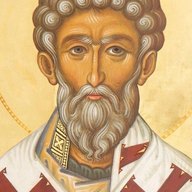
Blessed AugustineExposition on Psalm 122 · on Psalm 122:1
...Let this singer ascend; and let this man sing from the heart of each of you, and let each of you be this man, for when each of you saith this, since ye are all one in Christ, one man saith this; and saith not, "Unto Thee, O Lord, have" we "lift up" our "eyes;" but, "Unto Thee, O Lord, have I lift up mine eyes"…
Behold, as the eyes of servants are directed to the hands of their masters, And as the eyes of a maidservant to the hands of her mistress; So our eyes are directed to the Lord our God, Until he have mercy upon us.
Blessed AugustineExposition on Psalm 122 · on Psalm 122:2
What then followeth, since he hath said, "Unto Thee do I lift up mine eyes"? (ver. 2). How hast thou lifted up thine eyes? "Behold, even as the eyes of servants look unto the hand of their masters, and as the eyes of a maiden unto the hand of her mistress: even so our eyes wait upon the Lord our God, until He have…
Blessed AugustineExposition on Psalm 122 · on Psalm 122:3
"For we have been much filled with contempt". All that will live piously according to Christ, must needs suffer reproof, [2 Timothy 3:12] must needs be despised by those who do not choose to live piously, all whose happiness is earthly. They are derided who call that happiness which they cannot see with their eyes,…
Blessed AugustineExposition on Psalm 122 · on Psalm 122:4
"Our soul is filled exceedingly; a reproach to the wealthy, and a contempt to the proud" (ver. 4). We were asking who were "the wealthy:" he hath expounded to thee, in that he hath said, "the proud." "Reproach" and "contempt" are the same: and "wealthy" is the same with "proud." It is a repetition of the sentence, "a…
Every note is a real passage, quoted word for word from a published English translation, with its source. Nothing here is summarised or written by us. Some verses have many notes and some have none, because the Fathers wrote more on some passages than others.
Blessed Augustine, Expositions on the Book of Psalms, tr. A. Cleveland Coxe from the Oxford translation, Nicene and Post-Nicene Fathers, series 1, vol. 8 (1888).
Scripture: the Septuagint, in the translation of Sir Lancelot Brenton (1851), with spelling updated by Adam Boyd (2020); the Greek is Brenton's Septuagint text.
All of these translations are in the public domain. The passages were matched to their verses by the Historical Christian Commentaries project, which also hosts the full texts we link to. The Fathers are a treasury of the Church's mind, and they are best read alongside the life of the Church: if a passage raises a question, bring it to your priest.