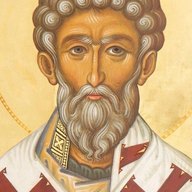
Blessed AugustineExposition on Psalm 145 · on Psalm 145:1
...Behold the Psalm soundeth; it is the voice of some one (and that some one are ye, if ye will), of some one encouraging his soul to praise God, and saying to himself, "Praise the Lord, O my soul" (ver. 1). For sometimes in the tribulations and temptations of this present life, whether we will or no, our soul is…
Blessed AugustineExposition on Psalm 145 · on Psalm 145:2
But who saith it, and to whom saith he it? What shall we say, brethren? Is it the flesh that saith, "Praise thou the Lord, O my soul"? And can the flesh suggest good counsel to the soul? However much the flesh be conquered, and subjected as a servant to us through strength which the Lord imparteth, that it serve us…
Blessed AugustineExposition on Psalm 145 · on Psalm 145:3
"Put not your trust in princes". Brethren, here we receive a mighty task; it is a voice from heaven, from above it sounds to us. For now through some kind of weakness the soul of man, whenever it is in tribulation here, despairs of God, and chooses to rely on man. Let it be said to one when set in some affliction,…
Blessed AugustineExposition on Psalm 145 · on Psalm 145:4
"His breath shall go forth, and he shall return to his earth: in that day shall all his thoughts perish" (ver. 4). Where is swelling? where is pride? where is boasting? But perhaps he will have passed to a good place, if indeed he have passed. For I know not whither he who spake thus hath passed. For he spake in…
Blessed AugustineExposition on Psalm 145 · on Psalm 145:5
What then must we do, if we are not to hope in sons of men, nor in princes? What must we do? "Blessed is he whose Helper is the God of Jacob" (ver. 5): not this man or that man; not this angel or that angel; but, "blessed is he whose Helper is the God of Jacob:" for to Jacob also so great an Helper was He, that of…
Blessed AugustineExposition on Psalm 145 · on Psalm 145:6
...Who is this, "Lord his God"? ..."To us there is one God, the Father, of whom are all things, and one Lord Jesus Christ, through whom are all things." Therefore let Him be thy hope, even the Lord thy God; in Him let thy hope be. His hope too is in the lord his god, who worshippeth Saturn; his hope is in the lord his…
Blessed AugustineExposition on Psalm 145 · on Psalm 145:7
"Who keepeth truth for ever." What "truth for ever"? what "truth" doth He "keep," and wherein doth "He keep it for ever"? "Who executeth judgment for them that suffer wrong." He avengeth them that suffer wrong. There cometh at once to thee the voice of the Apostle: "now therefore there is altogether a fault among you,…
Blessed AugustineExposition on Psalm 145 · on Psalm 145:8
"The Lord looses them that are fettered; the Lord lifts up them that are dashed down; the Lord makes wise them that are blind". Perfectly has he by this last sentence explained to us all the preceding ones: lest perchance, when he had said, "the Lord looses them that are fettered," we should refer it to those fettered…
Blessed AugustineExposition on Psalm 145 · on Psalm 145:9
Just as you have; "the Lord, guards proselytes". "Proselytes" are strangers. Every Church of the Gentiles is a stranger. For it comes in to the Fathers, not sprung of their flesh, but their daughter by imitating them. Yet the Lord, not any man, guards them. "The orphan and widow He will take up." Let none think that…
Blessed AugustineExposition on Psalm 145 · on Psalm 145:10
"And the way of sinners He shall root out." What is, "the way of sinners"? To mock at these things which we say. Who is an orphan, who a widow? What kingdom of heaven, what punishment of hell is there? These are fables of the Christians. To what I see, to that will I live: "let us eat and drink, for tomorrow we die."…
Every note is a real passage, quoted word for word from a published English translation, with its source. Nothing here is summarised or written by us. Some verses have many notes and some have none, because the Fathers wrote more on some passages than others.
Blessed Augustine, Expositions on the Book of Psalms, tr. A. Cleveland Coxe from the Oxford translation, Nicene and Post-Nicene Fathers, series 1, vol. 8 (1888).
Scripture: the Septuagint, in the translation of Sir Lancelot Brenton (1851), with spelling updated by Adam Boyd (2020); the Greek is Brenton's Septuagint text.
All of these translations are in the public domain. The passages were matched to their verses by the Historical Christian Commentaries project, which also hosts the full texts we link to. The Fathers are a treasury of the Church's mind, and they are best read alongside the life of the Church: if a passage raises a question, bring it to your priest.