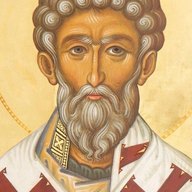
Blessed AugustineExposition on Psalm 150 · on Psalm 150:1
"Praise the Lord in His saints," that is, in those whom He hath glorified: "praise Him in the firmament of His power" (ver. 1). "Praise Him in His deeds of strength;" or, as others have explained it, "in His deeds of power: praise Him according to the multitude of His greatness" (ver. 2). All these His saints are; as…
Blessed AugustineExposition on Psalm 150 · on Psalm 150:2
"Praise Him in His deeds of strength;" or, as others have explained it, "in His deeds of power: praise Him according to the multitude of His greatness". Why should not they also be called "the works of" God's "strength," which He has done in them: yea rather, they themselves are the works of His strength; just as it…
Blessed AugustineExposition on Psalm 150 · on Psalm 150:3
"Praise Him in the sound of the trumpet": on account of the surpassing clearness of note of their praise. "Praise Him in the psaltery and harp." The psaltery praises God from things above, the harp praises God from things below; I mean, from things in heaven, and things in earth, as He who made heaven and earth. We…
Blessed AugustineExposition on Psalm 150 · on Psalm 150:4
"Praise Him in the timbrel and choir". The "timbrel" praises God when the flesh is now changed, so that there is in it no weakness of earthly corruption. For the timbrel is made of leather dried and strengthened. The "choir" praises God when society made peaceful praises Him. "Praise Him on the strings and organ."…
Blessed AugustineExposition on Psalm 150 · on Psalm 150:5
"Praise Him on the well-sounding cymbals, praise Him on cymbals of jubilation". Cymbals touch one another in order to sound, and therefore are by some compared to our lips. But I think it better to understand that God is in a manner praised on the cymbal, when each is honoured by his neighbour, not by himself, and…
Every note is a real passage, quoted word for word from a published English translation, with its source. Nothing here is summarised or written by us. Some verses have many notes and some have none, because the Fathers wrote more on some passages than others.
Blessed Augustine, Expositions on the Book of Psalms, tr. A. Cleveland Coxe from the Oxford translation, Nicene and Post-Nicene Fathers, series 1, vol. 8 (1888).
Scripture: the Septuagint, in the translation of Sir Lancelot Brenton (1851), with spelling updated by Adam Boyd (2020); the Greek is Brenton's Septuagint text.
All of these translations are in the public domain. The passages were matched to their verses by the Historical Christian Commentaries project, which also hosts the full texts we link to. The Fathers are a treasury of the Church's mind, and they are best read alongside the life of the Church: if a passage raises a question, bring it to your priest.