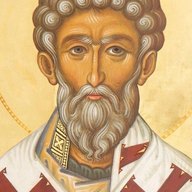
Blessed AugustineExposition on Psalm 91 · on Psalm 91:2
...We are not Christians, except on account of a future life: let no one hope for present blessings, let no one promise himself the happiness of the world, because he is a Christian: but let him use the happiness he hath, as he may, in what manner he may, when he may, as far as he may. When it is present, let him give…
Blessed AugustineExposition on Psalm 91 · on Psalm 91:3
"To tell of Your mercy early in the morning, and of Your truth in the night season". What is the meaning of this; that the mercy of God is to be told us in the morning, and in the night the truth of God? The morning is, when it is well with us; the night, the sadness of tribulation. What then did he say in brief? When…
On a psaltery of ten strings, with a song on the harp.
ἐν δεκαχόρδῳ ψαλτηρίῳ, μετʼ ᾠδῆς ἐν κιθάρᾳ.
Blessed AugustineExposition on Psalm 91 · on Psalm 91:4
"Upon a psaltery of ten strings, with a song, and upon the harp". You have not heard of the psaltery of ten strings for the first time: it signifies the ten commandments of the Law. But we must sing upon that psaltery, and not carry it only. For even the Jews have the Law: but they carry it: they sing not...."And upon…
Blessed AugustineExposition on Psalm 91 · on Psalm 91:5
"For Thou, Lord, hast made me glad through Thy works; and I will rejoice in giving praise for the operations of Thy hands". Ye see what he saith. Thou hast made me living well, Thou hast formed me: if by chance I do aught of good, I will rejoice in the work of Thy hands: as the Apostle saith, "For we are His…
Blessed AugustineExposition on Psalm 91 · on Psalm 91:6
Teaching us this, what saith he? "O Lord, how glorious are Thy works: Thy thoughts are made very deep". Verily, my brethren, there is no sea so deep as these thoughts of God, who maketh the wicked flourish, and the good suffer: nothing so profound, nothing so deep: therein every unbelieving soul is wrecked, in that…
Blessed AugustineExposition on Psalm 91 · on Psalm 91:7–8
For this reason, after saying, "Thy thoughts are very deep," he at once subjoins: "An unwise man doth not well consider this, and a fool doth not understand it". What are the things which an unwise man doth not well consider, and which a fool doth not understand? "When the ungodly are green as the grass." What is, "as…
Blessed AugustineExposition on Psalm 91 · on Psalm 91:9–10
"But Thou, Lord, art the Most Highest for evermore" (ver. 8). Waiting above in Thy eternity until the season of the wicked be past, and that of the just come. "For lo." Listen, brethren. Already he who speaketh (for he speaketh in our person, in the person of Christ's body, for Christ speaketh in His own body, that…
Blessed AugustineExposition on Psalm 91 · on Psalm 91:11
..."But mine horn shall be exalted like the horn of an unicorn". Why did He say, "like the horn of an unicorn"? Sometimes an unicorn signifies pride, sometimes it means the lifting up of unity; because unity is lifted up, all heresies shall perish with the enemies of God. And "mine horn shall be exalted like an…
Blessed AugustineExposition on Psalm 91 · on Psalm 91:12
"And My eye has beheld on mine enemies". Whom does he call his enemies? All the workers of iniquity. Do not observe whether your friend be wicked: let an occasion come, and then you prove him. Thou beginnest to go contrary to his iniquity, and then you shall see that when he was flattering you, he was your enemy; but…
Blessed AugustineExposition on Psalm 91 · on Psalm 91:13
The grass withers, the flower of sinners dies away: what of the righteous? "The righteous shall flourish like a palm tree". The ungodly are green as grass; "The righteous shall flourish like a palm tree." By the palm tree he signifies height. Possibly he had also this meaning in the palm, that in its extremities it is…
Blessed AugustineExposition on Psalm 91 · on Psalm 91:13–14
"Such as are planted in the house of the Lord, shall flourish in the courts of the house of our God". "They shall be yet more increased in fruitful old age, and shall be quiet, that they may show it forth". Such is the Sabbath, which but a little while ago I commended unto you, whence the Psalm hath its title. "They…
Every note is a real passage, quoted word for word from a published English translation, with its source. Nothing here is summarised or written by us. Some verses have many notes and some have none, because the Fathers wrote more on some passages than others.
Blessed Augustine, Expositions on the Book of Psalms, tr. A. Cleveland Coxe from the Oxford translation, Nicene and Post-Nicene Fathers, series 1, vol. 8 (1888).
Scripture: the Septuagint, in the translation of Sir Lancelot Brenton (1851), with spelling updated by Adam Boyd (2020); the Greek is Brenton's Septuagint text.
All of these translations are in the public domain. The passages were matched to their verses by the Historical Christian Commentaries project, which also hosts the full texts we link to. The Fathers are a treasury of the Church's mind, and they are best read alongside the life of the Church: if a passage raises a question, bring it to your priest.