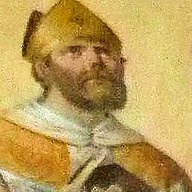
St. Victorinus of PettauCommentary on the Apocalypse · on Revelation 5:1
"And I saw in the right hand of Him that sate upon the throne, a book written within and without, sealed with seven seals." This book signifies the Old Testament, which has been given into the hands of our Lord Jesus Christ, who received from the Father judgment.
St. Victorinus of PettauCommentary on the Apocalypse · on Revelation 5:2–3
"And I saw an angel full of strength proclaiming with a loud voice, Who is worthy to open the book, and to loose the seals thereof? And no one was found worthy, neither in the earth nor under the earth, to open the book." Now to open the book is to overcome death for man.
St. Victorinus of PettauCommentary on the Apocalypse · on Revelation 5:4
"There was none found worthy to do this." Neither among the angels of heaven, nor among men in earth, nor among the souls of the saints in rest, save Christ the Son of God alone, whom he says that he saw as a Lamb standing as it were slain, having seven horns. What had not been then announced, and what the law had…
And one of the elders saith unto me, Weep not: behold, the Lion of the tribe of Juda, the Root of David, hath prevailed to open the book, and to loose the seven seals thereof.
St. Victorinus of PettauCommentary on the Apocalypse · on Revelation 5:5–7
"Lo, the Lion of the tribe of Judah, the root of David, hath prevailed." We read in Genesis that this lion of the tribe of Judah hath conquered, when the patriarch Jacob says, "Judah, thy brethren shall praise thee; thou hast lain down and slept, and hast risen up again as a lion, and as a lion's whelp." For He is…
And I beheld, and, lo, in the midst of the throne and of the four beasts, and in the midst of the elders, stood a Lamb as it had been slain, having seven horns and seven eyes, which are the seven Spirits of God sent forth into all the earth.
And when he had taken the book, the four beasts and four and twenty elders fell down before the Lamb, having every one of them harps, and golden vials full of odours, which are the prayers of saints.
St. Victorinus of PettauCommentary on the Apocalypse · on Revelation 5:8–9
"Twenty-four elders and four living creatures, having harps and phials, and singing a new song." The proclamation of the Old Testament associated with the New, points out the Christian people singing a new song, that is, bearing their confession publicly. It is a new thing that the Son of God should become man. It is…
And they sung a new song, saying, Thou art worthy to take the book, and to open the seals thereof: for thou wast slain, and hast redeemed us to God by thy blood out of every kindred, and tongue, and people, and nation;
And I beheld, and I heard the voice of many angels round about the throne and the beasts and the elders: and the number of them was ten thousand times ten thousand, and thousands of thousands;
Saying with a loud voice, Worthy is the Lamb that was slain to receive power, and riches, and wisdom, and strength, and honour, and glory, and blessing.
And every creature which is in heaven, and on the earth, and under the earth, and such as are in the sea, and all that are in them, heard I saying, Blessing, and honour, and glory, and power, be unto him that sitteth upon the throne, and unto the Lamb for ever and ever.
Every note is a real passage, quoted word for word from a published English translation, with its source. Nothing here is summarised or written by us. Some verses have many notes and some have none, because the Fathers wrote more on some passages than others.
St. Victorinus of Pettau, Commentary on the Apocalypse of the Blessed John, tr. Robert Ernest Wallis, Ante-Nicene Fathers, vol. 7 (1886).
Scripture: the King James Version (1611); the Greek (tap Ελ) is the 1904 Patriarchal text of the Ecumenical Patriarchate.
All of these translations are in the public domain. The passages were matched to their verses by the Historical Christian Commentaries project, which also hosts the full texts we link to. The Fathers are a treasury of the Church's mind, and they are best read alongside the life of the Church: if a passage raises a question, bring it to your priest.