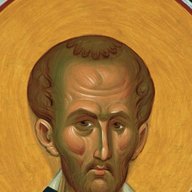
St. John ChrysostomHomily 17 on Romans · on Romans 10:1
He is now going again to rebuke them more vehemently than before. Wherefore he again does away with every suspicion of hatred, and makes a great effort beforehand to correct misapprehension. Do not then, he says, mind words or accusations, but observe that it is not in any hostile spirit that I say this. For it is not…
St. John ChrysostomHomily 17 on Romans · on Romans 10:2
"For I bear them record," says he, "that they have a zeal of God, but not according to knowledge." Ought not this then to be a ground for pardoning and not for accusing them? For if it is not of man that they are separated, but through zeal, they deserved to be pitied rather than punished. But observe how adroitly he…
For they being ignorant of God’s righteousness, and going about to establish their own righteousness, have not submitted themselves unto the righteousness of God.
St. John ChrysostomHomily 17 on Romans · on Romans 10:3
"For they being ignorant," he says, "of God's righteousness." Again the word would lead to pardon. But the sequel to stronger accusation, and such as does away with defence of any kind. "And going about," he says, "to establish their own righteousness, have not submitted themselves unto the righteousness of God." And…
For Christ is the end of the law for righteousness to every one that believeth.
τέλος γὰρ νόμου Χριστὸς εἰς δικαιοσύνην παντὶ τῷ πιστεύοντι.
St. John ChrysostomHomily 17 on Romans · on Romans 10:4
"For Christ is the end of the Law for righteousness to every one that believeth." See the judgment of Paul. For as he had spoken of a righteousness, and a righteousness, lest they of the Jews which believed should seem to have the one but be excluded from the other, and to be accused of lawlessness (for even these…
St. John ChrysostomHomily 17 on Romans · on Romans 10:5
"For Moses," he says, "describeth the righteousness which is of the Law." What he means is this. Moses showeth us the righteousness ensuing from the Law, what sort it is of, and whence. What sort is it then of, and what does it consist in? In fulfilling the commandments. "He (the man), that doeth these things," He…
But the righteousness which is of faith speaketh on this wise, Say not in thine heart, Who shall ascend into heaven? (that is, to bring Christ down from above:)
St. John ChrysostomHomily 17 on Romans · on Romans 10:6–9
"But the righteousness which is of faith speaketh on this wise, Say not in thine heart, Who shall ascend into heaven (that is, to bring Christ down from above): or, Who shall descend into the deep? (that is, to bring up Christ again from the dead.) But what saith it? The word is nigh thee, even in thy mouth, and in…
That if thou shalt confess with thy mouth the Lord Jesus, and shalt believe in thine heart that God hath raised him from the dead, thou shalt be saved.
St. John ChrysostomHomily 17 on Romans · on Romans 10:10
And what meaneth the phrase, "The Word is nigh thee?" That is, It is easy. For in thy mind and in thy tongue is thy salvation. There is no long journey to go, no seas to sail over, no mountains to pass, to get saved. But if you be not minded to cross so much as the threshold, you may even while you sit at home be…
St. John ChrysostomHomily 17 on Romans · on Romans 10:11–13
"For the Scripture saith," he proceeds, "Whosoever believeth on Him, shall not be ashamed. For there is no difference between the Jew and the Greek; for the same Lord over all is rich unto all that call upon Him. For whosoever shall call upon the Name of the Lord shall be saved." You see how he produces witnesses,…
How then shall they call on him in whom they have not believed? and how shall they believe in him of whom they have not heard? and how shall they hear without a preacher?
St. John ChrysostomHomily 18 on Romans · on Romans 10:14–15
"How then shall they call on Him in Whom they have not believed? and how shall they believe in Him of Whom they have not heard? and how shall they hear without a preacher? and how shall they preach except they be sent? as it is written." Here again he takes from them all excuse. For since he had said, "I bear them…
And how shall they preach, except they be sent? as it is written, How beautiful are the feet of them that preach the gospel of peace, and bring glad tidings of good things!
St. John ChrysostomHomily 18 on Romans · on Romans 10:16–17
"But they have not all obeyed the Gospel. For Esaias saith, Lord, who hath believed our report? So then faith cometh by hearing, and hearing by the word of God." Since they pressed him with another objection again to this effect, that if these were the persons sent upon the mission by God, all ought to have hearkened…
St. John ChrysostomHomily 18 on Romans · on Romans 10:18
"But I say, Have they not heard?" What, he means, if the preachers were sent, and did preach what they were bid, and these did not hear? Then comes a most perfect reply to the objection. "Yes, verily, their sound went into all the earth, and their words unto the ends of the world." What do you say? he means. They have…
But I say, Did not Israel know? First Moses saith, I will provoke you to jealousy by them that are no people, and by a foolish nation I will anger you.
St. John ChrysostomHomily 18 on Romans · on Romans 10:19
"But I say, Did not Israel know?" For what if they heard, he means, but did not know what was said, nor understand that these were the persons sent? Are they not to be forgiven for their ignorance? By no means. For Isaiah had described their character in the words, "How beautiful are the feet of them that preach the…
St. John ChrysostomHomily 18 on Romans · on Romans 10:20
"But Esaias is very bold, and saith." Now what he means is something of this kind. He put a violence on himself, and was ambitious to speak, not something veiled over, but to set things even naked before your eyes, and choosing rather to run into dangers from being plain spoken, than by looking to his own safety, to…
St. John ChrysostomHomily 18 on Romans · on Romans 10:21
"But unto Israel He saith, All the day long have I stretched forth My hands unto a disobedient and gainsaying people." Observe now that difficulty, which so many make a subject of question, is discovered laid up from of old in the words of the Prophet, and with a clear solution to it too. And what is this? You heard…
Every note is a real passage, quoted word for word from a published English translation, with its source. Nothing here is summarised or written by us. Some verses have many notes and some have none, because the Fathers wrote more on some passages than others.
St. John Chrysostom, Homilies on Romans, Nicene and Post-Nicene Fathers, series 1, vol. 11 (1888–1889).
Scripture: the King James Version (1611); the Greek (tap Ελ) is the 1904 Patriarchal text of the Ecumenical Patriarchate.
All of these translations are in the public domain. The passages were matched to their verses by the Historical Christian Commentaries project, which also hosts the full texts we link to. The Fathers are a treasury of the Church's mind, and they are best read alongside the life of the Church: if a passage raises a question, bring it to your priest.