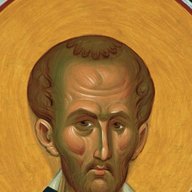
St. John ChrysostomHomily 16 on 1 Timothy · on 1 Timothy 6:1
"Let as many servants as are under the yoke count their masters worthy of all honor, that the Name of God and His doctrine be not blasphemed." Let them count them "worthy of all honor," he says; for do not suppose, because thou art a believer, that thou art therefore a free man: since thy freedom is to serve the more…
And they that have believing masters, let them not despise them, because they are brethren; but rather do them service, because they are faithful and beloved, partakers of the benefit. These things teach and exhort.
St. John ChrysostomHomily 16 on 1 Timothy · on 1 Timothy 6:2
"And they that have believing masters, let them not despise them because they are brethren, but rather do them service, because they are faithful and beloved partakers of the benefit." As though he had said, If ye are thought worthy of so great a benefit, as to have your masters for your brethren, on this account ye…
St. John ChrysostomHomily 17 on 1 Timothy · on 1 Timothy 6:2
"These things teach and exhort." A Teacher has need not only of authority, but of gentleness, and not only of gentleness, but of authority. And all these the blessed Paul teaches, at one time saying, "These things command and teach"; at another, "These things teach and exhort." For if physicians entreat the sick, not…
If any man teach otherwise, and consent not to wholesome words, even the words of our Lord Jesus Christ, and to the doctrine which is according to godliness;
St. John ChrysostomHomily 17 on 1 Timothy · on 1 Timothy 6:3
"If any man teach otherwise, and consent not to wholesome words, even the words of our Lord Jesus Christ, and to the doctrine which is according to godliness, he is proud, knowing nothing." Presumption therefore arises not from knowledge, but from "knowing nothing." For he that knows the doctrines of godliness is also…
St. John ChrysostomHomily 17 on 1 Timothy · on 1 Timothy 6:4
"Doting about questions." To question then is to dote. "And strifes of words"; this is justly said. For when the soul is fevered with reasonings, and stormy, then it questions, but when it is in a sound state, it does not question, but receives the faith. But from questionings and strifes of words nothing can be…
St. John ChrysostomHomily 17 on 1 Timothy · on 1 Timothy 6:5
"Perverse disputings," that is, leisure or conversation, or he may mean intercommunication, and that as infected sheep by contact communicate disease to the sound, so do these bad men. "Destitute of the truth, thinking that gain is godliness." Observe what evils are produced by strifes of words. The love of gain,…
St. John ChrysostomHomily 17 on 1 Timothy · on 1 Timothy 6:6
Having said, "They think that godliness is a means of gain," he adds: "But godliness with contentment is great gain," not when it possesses wealth, but when it has it not. For that he may not despond on account of his poverty, he encourages and revives his spirit. They think, he says, that godliness is a means of…
St. John ChrysostomHomily 17 on 1 Timothy · on 1 Timothy 6:7
"For we brought nothing into this world, and it is certain we can carry nothing out." For that worldly gain is nothing, is manifest, because it is left behind, and does not attend us, or go along with us at our departure. Whence is this plain? Because we had nothing when we came into this world, therefore we shall…
St. John ChrysostomHomily 17 on 1 Timothy · on 1 Timothy 6:8
"And having food and raiment, let us be therewith content." Such things, and so much ought we to eat, as will suffice to nourish us, and such things should we put on, as will cover us, and clothe our nakedness, and nothing more; and a common garment will answer this purpose.
St. John ChrysostomHomily 17 on 1 Timothy · on 1 Timothy 6:9
"But they that will be rich"; not those that are rich, but those who wish to be. For a man may have money and make a good use of it, not overvaluing it, but bestowing it upon the poor. Such therefore he does not blame, but the covetous. "They that will be rich fall into temptation and a snare, and into many foolish…
For the love of money is the root of all evil: which while some coveted after, they have erred from the faith, and pierced themselves through with many sorrows.
St. John ChrysostomHomily 17 on 1 Timothy · on 1 Timothy 6:10
"For the love of money is the root of all evil; which while some coveted after, they have erred from the faith, and pierced themselves through with many sorrows." Two things he mentions, and that which to them might seem the more weighty he places last, their "many sorrows." And to learn how true this is, the only way…
St. John ChrysostomHomily 17 on 1 Timothy · on 1 Timothy 6:11
"But thou, O man of God." This is a title of great dignity. For we are all men of God, but the righteous peculiarly so, not by right of creation only, but by that of appropriation. If then thou art a "man of God," seek not superfluous things, which lead thee not to God, but "Flee these things, and follow after…
St. John ChrysostomHomily 17 on 1 Timothy · on 1 Timothy 6:12
"Fight the good fight of faith, lay hold on eternal life." Lo, there is thy reward, "whereunto thou art also called, and hast professed a good profession," in hope of eternal life, "before many witnesses." That is, do not put that confidence to shame. Why dost thou labor to no profit? "Fight the good fight." Here he…
St. John ChrysostomHomily 18 on 1 Timothy · on 1 Timothy 6:13
Again he calls God to witness, as he had done a little before, at once to increase his disciple's awe, and to secure his safety, and to show that these were not human commandments, that receiving the commandment as from the Lord Himself, and ever bearing in mind the Witness before Whom he heard it, he may have it more…
That thou keep this commandment without spot, unrebukeable, until the appearing of our Lord Jesus Christ:
τηρῆσαί σε τὴν ἐντολὴν ἄσπιλον, ἀνεπίληπτον μέχρι τῆς ἐπιφανείας τοῦ Κυρίου ἡμῶν Ἰησοῦ Χριστοῦ,
St. John ChrysostomHomily 18 on 1 Timothy · on 1 Timothy 6:14
"That thou keep this commandment without spot, unrebukable, until the appearing of our Lord Jesus Christ." That is, till thy end, thy departure hence, though he does not so express it, but that he may the more arouse him, says, "till His appearing." But what is "to keep the commandment without spot"? To contract no…
St. John ChrysostomHomily 18 on 1 Timothy · on 1 Timothy 6:15
"Which in His times He shall show, Who is the blessed and only Potentate, King of kings, and Lord of lords, Who only hath immortality, dwelling in the light which no man can approach unto." Of whom are these things said? Of the Father, or of the Son? Of the Son, undoubtedly: and it is said for the consolation of…
Who only hath immortality, dwelling in the light which no man can approach unto; whom no man hath seen, nor can see: to whom be honour and power everlasting. Amen.
St. John ChrysostomHomily 18 on 1 Timothy · on 1 Timothy 6:16
"Dwelling in the light which no man can approach unto." Is He then Himself one Light, and is there another in which He dwells? is He then circumscribed by place? Think not of it. By this expression is represented the Incomprehensibleness of the Divine Nature. Thus he speaks of God, in the best way he is able. Observe,…
Charge them that are rich in this world, that they be not highminded, nor trust in uncertain riches, but in the living God, who giveth us richly all things to enjoy;
St. John ChrysostomHomily 18 on 1 Timothy · on 1 Timothy 6:17
"Charge them that are rich in this world that they be not high-minded." He has well said, "rich in this world." For there are others rich in the future world. And this advice he gives, knowing that nothing so generally produces pride and arrogance as wealth. To abate this, therefore, he immediately adds, "Nor trust in…
St. John ChrysostomHomily 18 on 1 Timothy · on 1 Timothy 6:18
"That they do good," he says, "that they be rich in good works, ready to distribute willing to communicate." The first phrase refers to wealth, the second to charity. For to be willing to communicate, implies that they are sociable and kind.
St. John ChrysostomHomily 18 on 1 Timothy · on 1 Timothy 6:19
"Laying up in store for themselves a good foundation against the time to come." There nothing is uncertain, for the foundation being firm, there is no instability, all is firm, fixed, immovable, fast, and enduring. "That they may lay hold," he says, "on eternal life." For the doing of good works can secure the…
St. John ChrysostomHomily 18 on 1 Timothy · on 1 Timothy 6:20
"O Timothy, keep that which is committed to thy trust." Let it not suffer diminution. It is not thy own. Thou art intrusted with the property of another, do not lessen it. "Avoiding profane and vain babblings, and oppositions of science falsely so called." Well did he thus call it. For where there is not faith, there…
St. John ChrysostomHomily 18 on 1 Timothy · on 1 Timothy 6:21
"Which some professing have erred concerning the faith." You see how again he commands Timothy not even to meet them. "Avoiding opposition." There are therefore oppositions to which we ought not to vouchsafe an answer, because they turn men from faith, and do not suffer one to be firmly established or fixed in it. Let…
Every note is a real passage, quoted word for word from a published English translation, with its source. Nothing here is summarised or written by us. Some verses have many notes and some have none, because the Fathers wrote more on some passages than others.
St. John Chrysostom, Homilies on 1 Timothy, Nicene and Post-Nicene Fathers, series 1, vol. 13 (1888–1889).
Scripture: the King James Version (1611); the Greek (tap Ελ) is the 1904 Patriarchal text of the Ecumenical Patriarchate.
All of these translations are in the public domain. The passages were matched to their verses by the Historical Christian Commentaries project, which also hosts the full texts we link to. The Fathers are a treasury of the Church's mind, and they are best read alongside the life of the Church: if a passage raises a question, bring it to your priest.