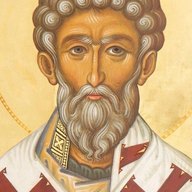
St. Bede the Venerablein the Catena Aurea · on Mark 7:1
The people of the land of Gennesareth, who seemed to be unlearned men, not only come themselves, but also bring their sick to the Lord, that they may but succeed in touching the hem of His garment. But the Pharisees and Scribes, who ought to have been the teachers of the people, run together to the Lord, not to seek…
Blessed Theophylact of Ohridin the Catena Aurea · on Mark 7:2
For the disciples of the Lord, who were taught only the practice of virtue, used to eat in a simple way, without washing their hands; but the Pharisees, wishing to find an occasion of blame against them, took it up; they did not indeed blame them as transgressors of the law, but for transgressing the traditions of the…
And when they come from the market, except they wash, they eat not. And many other things there be, which they have received to hold, as the washing of cups, and pots, brasen vessels, and of tables.
St. Bede the Venerablein the Catena Aurea · on Mark 7:4
For taking the spiritual words of the Prophets in a carnal sense, they observed, by washing the body alone, commandments which concerned the chastening of the heart and deeds, saying Wash you, make you clean; (Isa. 1:16) and again, Be ye clean that bear the vessels of the Lord. (Isa. 52:11) It is therefore a…
He answered and said unto them, Well hath Esaias prophesied of you hypocrites, as it is written, This people honoureth me with their lips, but their heart is far from me.
For Moses said, Honour thy father and thy mother; and, Whoso curseth father or mother, let him die the death:
Μωϋσῆς γὰρ εἶπε· τίμα τὸν πατέρα σου καὶ τὴν μητέρα σου· καί ὁ κακολογῶν πατέρα ἢ μητέρα θανάτῳ τελευτάτω·
TO
Blessed Theophylact of Ohridin the Catena Aurea · on Mark 7:10–13
For the Pharisees, wishing to devour the offerings, instructed sons, when their parents asked for some of their property, to answer them, what thou hast asked of me is corban, that is, a gift, I have already offered it up to the Lord; thus the parents would not require it, as being offered up to the Lord, (and in that…
St. Bede the Venerablein the Catena Aurea · on Mark 7:10
The sense of the word honour in Scripture is not so much the saluting and paying court to men, as alms-giving, and bestowing gifts; honour, says the Apostle, widows who are widows indeed. (1 Tim. 5:3.)
But ye say, If a man shall say to his father or mother, It is Corban, that is to say, a gift, by whatsoever thou mightest be profited by me; he shall be free.
St. Bede the Venerablein the Catena Aurea · on Mark 7:11
The passage may in a few words have this sense, Every gift which I have to make, will go to do you good; for ye compel children, it is meant, to say to their parents, that gift which I was going to offer to God, I expend on feeding you, and does you good, oh father and mother, speaking this ironically. Thus they would…
Blessed Theophylact of Ohridin the Catena Aurea · on Mark 7:14–15
But the intention of the Lord in saying this was to teach men, that the observing of meats, which the law commands, should not be taken in a carnal sense, and from this He began to unfold to them the intent of the law.
St. Bede the Venerablein the Catena Aurea · on Mark 7:15
For the Jews, boasting themselves to be the portion of God, call common those meats which all men use, as shellfish, hares, and animals of that sort. Not even however what is offered to idols is unclean, in as far as it is food and God's creature; it is the invocation of devils which makes it unclean; and He adds the…
Blessed Theophylact of Ohridin the Catena Aurea · on Mark 7:17–19
The Lord begins by chiding them, wherefore there follows, Are ye so without understanding also? Then the Lord shows them what was hidden, saying, Do ye not perceive, that whatsoever thing from without entereth into the man, it cannot make him common?
And he saith unto them, Are ye so without understanding also? Do ye not perceive, that whatsoever thing from without entereth into the man, it cannot defile him;
Blessed Augustinein the Catena Aurea · on Mark 7:19
For some things are joined to others in such a way as both to change and be changed, just as food, losing its former appearance, is both itself turned into our body, and we too are changed, and our strength is refreshed by it.b Further, a most subtle liquid, after the food has been prepared and digested in our veins,…
St. Bede the Venerablein the Catena Aurea · on Mark 7:20
Thus then it is not meat that makes men unclean, but wickedness, which works in us the passions which come from within; wherefore it goes on: And he said, That which cometh out of a man, that defileth a man.
Blessed Theophylact of Ohridin the Catena Aurea · on Mark 7:21–23
An evil eye, that is, hatred and flattery, for he who hates turns an evil and envious eye on him whom he hates, and a flatterer, looking askance at his neighbour's goods, leads him into evil; blasphemies, that is, faults committed against God; pride, that is, contempt of God, when a man ascribes the good, which he…
St. Bede the Venerablein the Catena Aurea · on Mark 7:21
From this passage are condemned those men who suppose that thoughts are put into them by the devil, and do not arise from their own evil will. The devil may excite and help on evil thoughts, he cannot be their author.
And from thence he arose, and went into the borders of Tyre and Sidon, and entered into an house, and would have no man know it: but he could not be hid.
Blessed AugustineHarmony of the Gospels, Book 2 · on Mark 7:24–27
Matthew, accordingly, proceeds with his narrative, after the notice of that discourse which the Lord delivered in the presence of the Pharisees on the subject of the unwashed hands. Preserving also the order of the succeeding events, as far as it is indicated by the transitions from the one to the other, he introduces…
Blessed Augustinein the Catena Aurea · on Mark 7:24–26
It appears however that some question about a discrepancy may be raised, because it is said that the Lord was in the house when the woman came to her, asking about her daughter. When, however, Matthew says that His disciples had suggested to Him, Send her away, for she crieth after us, (Matt. 15:23) he appears to…
Blessed Theophylact of Ohridin the Catena Aurea · on Mark 7:24
After that the Lord had finished His teaching concerning food, seeing that the Jews were incredulous, He enters into the country of the Gentiles, for the Jews being unfaithful, salvation turns itself to the Gentiles; wherefore it is said, And from thence he arose, and went into the borders of Tyre and Sidon.…
St. Bede the Venerablein the Catena Aurea · on Mark 7:24
Having entered also into the house, He commanded His disciples not to betray who He was to any one in this unknown region, that they, on whom He had bestowed the grace of healing, might learn by His example, as far as they could, to shrink from the glory of human praise in the showing forth of their miracles; yet they…
Blessed Theophylact of Ohridin the Catena Aurea · on Mark 7:27
He calls the Gentiles dogs, as being thought wicked by the Jews; and He means by bread, the benefit which the Lord promised to the children, that is, to the Jews. The sense therefore is, that it is not right for the Gentiles first to be partakers of the benefit, promised principally to the Jews. The reason, therefore,…
St. Bede the Venerablein the Catena Aurea · on Mark 7:27
The time will come when even you who are Gentiles will obtain salvation; but it is right that first the Jews who deservedly are wont to be called by the name of children of God's ancient election, should be refreshed with heavenly bread, and that so at length, the food of life should be ministered to the Gentiles.…
Blessed Theophylact of Ohridin the Catena Aurea · on Mark 7:28
As if she had said, The Jews have the whole of that bread which comes down from heaven, and Thy benefits also; I ask for the crumbs, that is, a small portion of the benefit.
Blessed Theophylact of Ohridin the Catena Aurea · on Mark 7:29–30
Because therefore the woman answered with much wisdom, she obtained what she wanted; wherefore there follows, And he said unto her, &c. He said not, My virtue hath made thee whole, but for this saying, that is, for thy faith, which is shown by this saying, go thy way, the devil is gone out of thy daughter. It goes on,…
St. Bede the Venerablein the Catena Aurea · on Mark 7:29
On account then of the humble and faithful saying of her mother, the devil left the daughter; here is given a precedent for catechising and baptizing infants, seeing that by the faith and the confession of the parents, infants are freed in baptism from the devil, though they can neither have knowledge in themselves,…
Blessed Theophylact of Ohridin the Catena Aurea · on Mark 7:31–32
The Lord did not wish to stay in the parts of the Gentiles, lest He should give the Jews occasion to say, that they esteemed Him a transgressor of the law, because He held communion with the Gentiles, and therefore He immediately returns; wherefore it is said, And again departing from the coasts of Tyre, he came…
St. Bede the Venerablein the Catena Aurea · on Mark 7:31
Decapolis is a region of ten cities, across the Jordan, to the east, over against Galilee.c When therefore it is said that the Lord came to the sea of Galilee, through the midst of the borders of Decapolis, it does not mean that He entered the confines of Decapolis themselves; for He is not said to have crossed the…
St. Bede the Venerablein the Catena Aurea · on Mark 7:32
Or he is deaf and dumb, who neither has ears to hear the words of God, nor opens his mouth to speak them, and such must be presented to the Lord for healing, by men who have already learned to hear and speak the divine oracles.
Blessed Theophylact of Ohridin the Catena Aurea · on Mark 7:33
That He might show that all the members of His sacred body are divine and holy, even the spittle which loosed the string of the tongue. For the spittle is only the superfluous moisture of the body, but in the Lord all things are divine. It goes on, And looking up to heaven, he groaned, and saith unto him, Ephphatha,…
St. Bede the Venerablein the Catena Aurea · on Mark 7:34
He looked up to heaven, that He might teach us that thence is to be procured speech for the dumb, hearing for the deaf, health for all who are sick. And He sighed, not that it was necessary for Him to beg any thing from His Father with groaning, for He, together with the Father, gives all things to them who ask, but…
St. Bede the Venerablein the Catena Aurea · on Mark 7:34
But that which He says, Ephphatha, that is, Be opened, belongs properly to the ears, for the ears are to be opened for hearing, but the tongue to be loosed from the bonds of its impediment, that it may be able to speak.
St. Bede the Venerablein the Catena Aurea · on Mark 7:35
Wherefore it goes on, And straightway his ears were opened, and the string of his tongue was loosed, and he spake plain. Where each nature of one and the same Christ is manifestly distinct, looking up indeed into Heaven as man, praying unto God, He groaned, but presently with one word, as being strong in the Divine…
Blessed AugustineHarmony of the Gospels, Book 4 · on Mark 7:36
Mark continues in these terms: "And He said unto them, Come ye apart into a desert place, and rest a while;" and so on, down to the words, "But the more He charged them, so much the more a great deal they published it; and were beyond measure astonished, saying, He hath done all things well: He maketh both the deaf to…
Blessed Theophylact of Ohridin the Catena Aurea · on Mark 7:36–37
By this we are taught, when we confer benefits on any, by no means to seek for applause and praise; but when we have received benefits, to proclaim and praise our benefactors, even though they be unwilling.
Every note is a real passage, quoted word for word from a published English translation, with its source. Nothing here is summarised or written by us. Some verses have many notes and some have none, because the Fathers wrote more on some passages than others.
Blessed Augustine, The Harmony of the Gospels, tr. S. D. F. Salmond, Nicene and Post-Nicene Fathers, series 1, vol. 6 (1888).
Chrysostom, Augustine, Cyril, Theophylact, Ambrose, Gregory and Bede, as gathered in the Catena Aurea ("golden chain"), tr. J. H. Newman and others (Oxford, 1841–1845). In the 1260s Thomas Aquinas set the Fathers' comments on each verse of the Gospels side by side. He chose and arranged them, but every word is the Father's own.
Scripture: the King James Version (1611); the Greek (tap Ελ) is the 1904 Patriarchal text of the Ecumenical Patriarchate.
All of these translations are in the public domain. The passages were matched to their verses by the Historical Christian Commentaries project, which also hosts the full texts we link to. The Fathers are a treasury of the Church's mind, and they are best read alongside the life of the Church: if a passage raises a question, bring it to your priest.