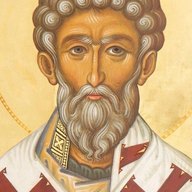
Blessed Theophylact of Ohridin the Catena Aurea · on Mark 3:1–2
After confounding the Jews, who had blamed His disciples, for pulling the ears of corn on the sabbath day, by the example of David, the Lord now further bringing them to the truth, works a miracle on the sabbath; showing that, if it is a pious deed to work miracles on the sabbath for the health of men, it is not wrong…
St. Bede the Venerablein the Catena Aurea · on Mark 3:1
But mystically, the man with a withered hand shows the human race, dried up as to its fruitfulness in good works, but now cured by the mercy of the Lord; the hand of man, which in our first parent had been dried up when he plucked the fruit of the forbidden tree, through the grace of the Redeemer, Who stretched His…
Blessed AugustineHarmony of the Gospels, Book 2 · on Mark 3:2–5
But it is possible that a difficulty may be felt in the circumstance that Matthew has told us how the people put this question to the Lord, "Is it lawful to heal on the Sabbath-day?" wishing thereby to find an occasion for accusing Him; and that in reply He set before them the parable of the sheep in these terms:…
St. Bede the Venerablein the Catena Aurea · on Mark 3:2
For, since He had defended the breaking of the sabbath, which they objected to His disciples, by an approved example, now they wish, by watching Him, to calumniate Himself, that they might accuse Him of a transgression, if He cured on the sabbath, of cruelty or of folly, if He refused. It goes on: And he saith unto…
Blessed Theophylact of Ohridin the Catena Aurea · on Mark 3:3
Or, he has his right hand withered, who does not the works which belong to the right side; for from the time that our hand is employed in forbidden deeds, from that time it is withered to the working of good. But it will be restored whenever it stands firm in virtue; wherefore Christ saith, Arise, that is, from sin,…
Blessed Augustinein the Catena Aurea · on Mark 3:4
But some one may wonder how Matthew could have said, that they themselves asked the Lord, if it was lawful to heal on the sabbath-day; when Mark rather relates that they were asked by our Lord, Is it lawful to do good on the sabbath-day, or to do evil? Therefore we must understand that they first asked the Lord, if it…
St. Bede the Venerablein the Catena Aurea · on Mark 3:4
And anticipating the calumny of the Jews, which they had prepared for Him, He accused them of violating the precepts of the law, by a wrong interpretation. Wherefore there follows: And he saith unto them, Is it lawful to do good on the sabbath-day, or to do evil? And this He asks, because they thought that on the…
And when he had looked round about on them with anger, being grieved for the hardness of their hearts, he saith unto the man, Stretch forth thine hand. And he stretched it out: and his hand was restored whole as the other.
Blessed Theophylact of Ohridin the Catena Aurea · on Mark 3:6
But the soldiers of Herod the king are called Herodians, because a certain new heresy had sprung up, which asserted that Herod was the Christ. For the prophecy of Jacob intimated, that when the princes of Judah failed, then Christ should come; because therefore in the time of Herod none of the Jewish princes remained,…
Blessed Theophylact of Ohridin the Catena Aurea · on Mark 3:6
Morally again, the Herodians, that is, persons who love the lusts of the flesh, wish to slay Christ. For the meaning of Herod is, 'of skin.' (pelliceus. v. Hier. de Nom. Hebr)
St. Bede the Venerablein the Catena Aurea · on Mark 3:6
The Pharisees, thinking it a crime that at the word of the Lord the hand which was diseased was restored to a sound state, agreed to make a pretext of the words spoken by our Saviour; wherefore it is said, And the Pharisees went forth, and straightway took counsel with the Herodians against him, how they might destroy…
Blessed AugustineHarmony of the Gospels, Book 2 · on Mark 3:7–13
Matthew continues his narrative, connecting it in the following manner with what precedes: "But the Pharisees went out and held a council against Him, how they might destroy Him. But when Jesus knew it, He withdrew Himself from thence: and great multitudes followed Him, and He healed them all; and charged them that…
St. Bede the Venerablein the Catena Aurea · on Mark 3:7
It goes on, But Jesus withdrew himself with his disciples to the sea; He fled from their treachery, because the hour of His passion had not yet come, and no place away from Jerusalem was proper for His Passion. By which also He gave an example to His disciples, when they suffer persecution in one city, to flee to…
St. Bede the Venerablein the Catena Aurea · on Mark 3:7–9
For the strangers followed Him, because they saw the works of His powers, and in order to hear the words or His teaching. But the Jews, induced solely by their opinion of His powers, in a vast multitude come to hear Him, and to beg for His aiding health; wherefore there follows, And he spake to his disciples, that…
And from Jerusalem, and from Idumaea, and from beyond Jordan; and they about Tyre and Sidon, a great multitude, when they had heard what great things he did, came unto him.
Blessed Theophylact of Ohridin the Catena Aurea · on Mark 3:8
Syrians and Sidonians, being foreigners, receive benefit from Christ; but His kindred the Jews persecute Him: thus there is no profit in relationship, if there be not a similarity in goodness.
Blessed Theophylact of Ohridin the Catena Aurea · on Mark 3:8
But those who quit their country, that is, a carnal mode of living, follow Christ, and their plagues are healed, that is, the sins which wound their conscience.
Blessed Theophylact of Ohridin the Catena Aurea · on Mark 3:9
But Jesus in us is our reason, which commands that our vessel, that is, our body, should serve Him, lest the troubles of worldly affairs should press upon our reason.
St. Bede the Venerablein the Catena Aurea · on Mark 3:10–12
Both therefore fell down before the Lord, those who had the plagues of bodily diseases, and those who were vexed by unclean spirits. The sick did this simply with the intention of obtaining health, but the demoniacs, or rather the devils within them, because under the mastery of a fear of God they were compelled not…
Blessed Theophylact of Ohridin the Catena Aurea · on Mark 3:13
Luke, however, says that He went up to pray, for after the showing forth of miracles He prays, teaching us that we should give thanks, when we obtain any thing good, and refer it to Divine grace.
St. Bede the Venerablein the Catena Aurea · on Mark 3:13–14
After having forbidden the evil spirits to preach Him, He chose holy men, to cast out the unclean spirits, and to preach the Gospel; wherefore it is said, And he went up into a mountain, &c. (Luke 6) For it was not a matter of their choice and zeal, but of Divine condescension and grace, that they should be called to…
St. Bede the Venerablein the Catena Aurea · on Mark 3:14–15
For as a sacrament of this the children of Israel once used to encamp about the Tabernacle, so that on each of the four sides of the square three tribes were stationed. Now three times four are twelve, and in three bands of four the Apostles were sent to preach, that through the four quarters of the whole world they…
Blessed AugustineHarmony of the Gospels, Book 2 · on Mark 3:16
I recollect having already stated that no one should suppose that Peter received that name for the first time on the occasion when He said to Him, "Thou art Peter, and upon this rock I will build my Church." For the time at which he did obtain this name was that referred to by John, when he mentions that he was…
Blessed AugustineHarmony of the Gospels, Book 4 · on Mark 3:16
Mark proceeds thus: "And He goeth up into a mountain, and calleth unto Him whom He would: and they came unto Him. And He ordained twelve that they should be with Him, and that He might send them forth to preach; and He gave them power to heal sicknesses, and to cast out devils. And Simon He surnamed Peter;" and so on,…
Blessed Augustinein the Catena Aurea · on Mark 3:16
But let no one suppose that Simon now received his name and was called Peter, for thus he would make Mark contrary to John, who relates that it had been long before said unto him, Thou shalt be called Cephas. (John 1:42) But Mark gives this account by way of recapitulation; for as he wished to give the names of the…
Blessed Theophylact of Ohridin the Catena Aurea · on Mark 3:16
Further, He gives the names of the Apostles, that the true Apostles might be known, so that men might avoid the false. And therefore it continues: And Simon he surnamed Cephas.
St. Bede the Venerablein the Catena Aurea · on Mark 3:16
And the reason that the Lord willed that he should at first be called otherwise, was that from the change itself of the name, a mystery might be conveyed to us. Peter then in Latin or in Greek means the same thing as Cephas in Hebrew, and in each language the name is drawn from a stone. Nor can it be doubted that is…
St. Bede the Venerablein the Catena Aurea · on Mark 3:18
We must connect this with what went before, He goeth up into a mountain, and calleth. For Andrew is a Greek name, which means 'manly,' from ἀνὴδ, that is, man, for he manfully adhered to the Lord. There follows, And Philip.
St. Bede the Venerablein the Catena Aurea · on Mark 3:18–19
But Thaddæus is the same person, as Luke calls in the Gospel and in the Acts, Jude of James, for he was the brother of James, the brother of the Lord, as he himself has written in his Epistle. There follows, And Simon the Canaanite, and Judas Iscariot, who betrayed him. He has added this by way of distinction from…
And Judas Iscariot, which also betrayed him: and they went into an house.
καὶ Ἰούδαν Ἰσκαριώτην, ὃς καὶ παρέδωκεν αὐτόν.
TO
Blessed Theophylact of Ohridin the Catena Aurea · on Mark 3:19
Whom he reckons amongst the Apostles, that we may learn that God does not repel any man for wickedness, which is future, but counts him worthy on account of his present virtue.
Blessed Theophylact of Ohridin the Catena Aurea · on Mark 3:20–21
That is, He has a devil and is mad, and therefore they wished to lay hold upon Him, that they might shut Him up as one who had a devil. And even His friends wished to do this, that is, His relations, perchance His countrymen, or His brethren. 1But it was a silly insanity in them, to conceive that the Worker of such…
St. Bede the Venerablein the Catena Aurea · on Mark 3:20
The Lord leads the Apostles, when they were elected, into a house, as if admonishing them, that after having received the Apostleship, they should retire to look on their own consciences. Wherefore it is said, And they came into a house, and the multitude came together again, so that they could not eat bread.
St. Bede the Venerablein the Catena Aurea · on Mark 3:21
And blessed indeed the concourse of the crowd, flocking together, whose anxiety to obtain salvation was so great, that they left not the Author of salvation even an hour free to take food. But Him, whom a crowd of strangers loves to follow, his relations hold in little esteem: for it goes on: And when his friends…
Blessed AugustineHarmony of the Gospels, Book 2 · on Mark 3:22
Matthew proceeds with his narrative in the following terms: "And all the people were amazed, and said, Is not this the son of David? But when the Pharisees heard it, they said, This fellow doth not cast out devils but in Beelzebub, the prince of the devils. And Jesus knew their thoughts, and said unto them, Every…
St. Bede the Venerablein the Catena Aurea · on Mark 3:22
Now there is a great difference between those who do not understand the word of God from slowness of intellect, such as those, who are here spoken of, and those who purposely blaspheme, of whom it is added, And the Scribes which came down from Jerusalem, &c. For what they could not deny, they endeavour to pervert by a…
Blessed Theophylact of Ohridin the Catena Aurea · on Mark 3:27
The meaning of the example is this: The devil is the strong man; his goods are the men into whom he is received; unless therefore a man first conquers the devil, how can he deprive him of his goods, that is, of the men whom he has possessed? So also I who spoil his goods, that is, free men from suffering by his…
St. Bede the Venerablein the Catena Aurea · on Mark 3:27
The Lord has also bound the strong man, that is, the devil: which means, He has restrained him from seducing the elect, and entering into his house, the world; He has spoiled his house, and his goods, that is men, because He has snatched them from the snares of the devil, and has united them to His Church. Or, He has…
Blessed Theophylact of Ohridin the Catena Aurea · on Mark 3:28
We must however understand, that they will not obtain pardon unless they repent. But since it was at the flesh of Christ that they were offended, even though they did not repent, some excuse was allowed them, and they obtained some remission.
St. Bede the Venerablein the Catena Aurea · on Mark 3:28–29
But the Lord shows that they committed a great sin, in crying out that that which they knew to be of God, was of the devil, when He subjoins, Verily I say unto you, All sins are forgiven, &c. All sins and blasphemies are not indeed remitted to all men, but to those who have gone through a repentance in this life…
Blessed Augustinein the Catena Aurea · on Mark 3:29–30
Or else impenitence itself is the blasphemy against the Holy Ghost which hath no remission. For either in his thought or by his tongue, he speaks a word against the Holy Ghost the forgiver of sins, who treasures up for himself an impenitent heart. But he subjoins, Because they said, He hath an unclean spirit, that he…
Blessed AugustineHarmony of the Gospels, Book 2 · on Mark 3:31
Matthew then proceeds with his narrative in the following terms: "While He yet talked to the people, behold, His mother and His brethren stood without, desiring to speak to Him;" and so on, down to the words, "For whosoever shall do the will of my Father which is in heaven, the same is my brother, and sister, and…
Blessed Theophylact of Ohridin the Catena Aurea · on Mark 3:31–32
Because the relations of the Lord had come to seize upon Him, as if beside Himself, His mother, urged by the sympathy of her love, came to Him; wherefore it is said, And there came unto him his mother, and, standing without, sent unto him, calling him.
St. Bede the Venerablein the Catena Aurea · on Mark 3:31
The brothers of the Lord must not be thought to be the sons of the ever-virgin Mary, as Helvidius sayp, nor the sons of Joseph by a former marriage, as some think, but rather they must be understood to be His relations.
St. Bede the Venerablein the Catena Aurea · on Mark 3:31–32
But mystically, the mother and brother of Jesus means the synagogue, (from which according to the flesh He sprung,) and the Jewish people who, while the Saviour is teaching within, come to Him, and are not able to enter, because they cannot understand spiritual things. But the crowd eagerly enter, because when the…
Blessed Theophylact of Ohridin the Catena Aurea · on Mark 3:33–35
He does not therefore say this, as denying His mother, but as showing that He is worthy of honour, not only because she bore Christ, but on account of her possessing every other virtue.
St. Bede the Venerablein the Catena Aurea · on Mark 3:33–34
Being asked therefore by a message to go out, He declines, not as though He refused the dutiful service of His mother, but to show that He owes more to His Father's mysteries than to His mother's feelings. Nor does He rudely despise His brothers, but, preferring His spiritual work to fleshly relationship, He teaches…
Every note is a real passage, quoted word for word from a published English translation, with its source. Nothing here is summarised or written by us. Some verses have many notes and some have none, because the Fathers wrote more on some passages than others.
Blessed Augustine, The Harmony of the Gospels, tr. S. D. F. Salmond, Nicene and Post-Nicene Fathers, series 1, vol. 6 (1888).
Chrysostom, Augustine, Cyril, Theophylact, Ambrose, Gregory and Bede, as gathered in the Catena Aurea ("golden chain"), tr. J. H. Newman and others (Oxford, 1841–1845). In the 1260s Thomas Aquinas set the Fathers' comments on each verse of the Gospels side by side. He chose and arranged them, but every word is the Father's own.
Scripture: the King James Version (1611); the Greek (tap Ελ) is the 1904 Patriarchal text of the Ecumenical Patriarchate.
All of these translations are in the public domain. The passages were matched to their verses by the Historical Christian Commentaries project, which also hosts the full texts we link to. The Fathers are a treasury of the Church's mind, and they are best read alongside the life of the Church: if a passage raises a question, bring it to your priest.