The Eastern Cross/Guides/Orthodox Christmas
The Nativity of Christ
Orthodox Christmas
Every Orthodox Christian keeps Christmas on December 25. For the churches that still follow the old Julian calendar, that December 25 falls on January 7. Here is why, and how the feast is kept.
Two calendars
Why January 7?
Until the 1500s nearly all Christians used the Julian calendar, set up by Julius Caesar. It runs a little long, gaining a day every 128 years or so. In 1582 Pope Gregory XIII fixed it, and Western Europe moved to the new Gregorian calendar, the one on your phone. The Orthodox Church kept the old one.
Today the two are thirteen days apart. So December 25 on the Julian calendar is January 7 on the civil calendar. The Orthodox who keep Christmas on January 7 aren't celebrating a different day: they are keeping December 25 by the calendar the Church has always used.
In 1923 a meeting called by the Patriarch of Constantinople proposed the Revised Julian calendar, which matches the civil calendar for fixed feasts. Greece, Romania and others adopted it; Russia, Serbia, Jerusalem and others did not. Pascha is still reckoned the old way by almost everyone, which is why Orthodox Easter usually comes later than Western Easter.
December 25
Revised Julian (New) Calendar
- Constantinople (the Ecumenical Patriarchate)
- Alexandria
- Antioch
- Greece
- Cyprus
- Romania
- Bulgaria
- Albania
- The Orthodox Church in America (most parishes)
- The Orthodox Church of Ukraine (since 2023)
January 7
Julian (Old) Calendar
- Jerusalem
- Russia, with the Russian Church Outside Russia
- Serbia
- Georgia
- Mount Athos
- North Macedonia
- Poland
- The Ukrainian Orthodox Church and many Ukrainian parishes
Both groups are fully Orthodox and in the same faith. Within one country, and sometimes one city, you can find parishes of each. The gap grows by a day in 2100, so from 2101 Old Calendar Christmas will fall on January 8.
History
Why December 25 at all?
The Gospels don't give a date. The earliest record of a Christmas feast on December 25 is a Roman calendar list from the year 336, kept in a book known as the Chronograph of 354: "Christ born in Bethlehem of Judea."
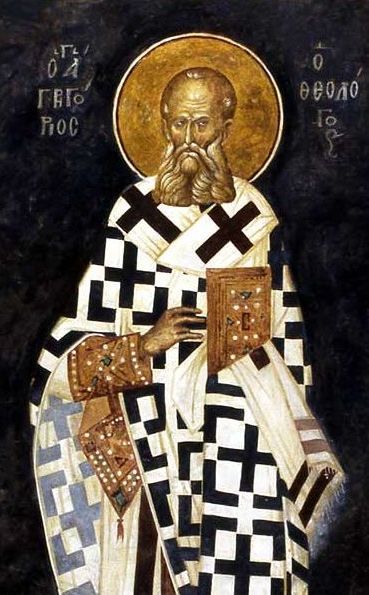
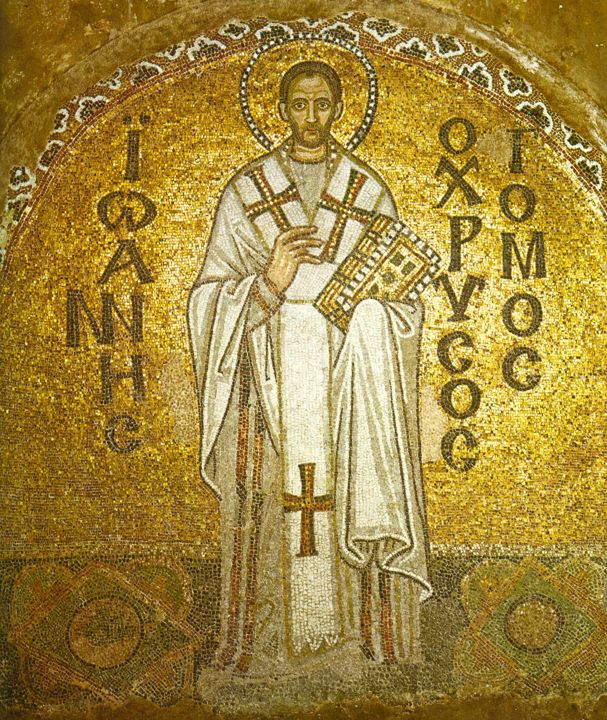
In the East, the birth of Christ was first celebrated together with His baptism on January 6, the Theophany. The December date spread east later in the 300s. St. John Chrysostom told his congregation in Antioch in 386 that the feast had reached them less than ten years before, and St. Gregory the Theologian preached his great Christmas oration in Constantinople around 380. The Armenian Church still keeps the two feasts together on January 6.
Why December 25? Historians give two answers. One says the Church chose a day the pagans already kept for the sun god, Sol Invictus, to replace it with the true Sun of Righteousness. The other says early Christians reckoned that Christ was conceived on the same day He died, which they dated to March 25, and nine months on is December 25. Both ideas are old, and scholars still argue about them. The Church's hymns happily use the first image: Christ is the Sun who rose on a world in darkness.
The feast
What Christmas celebrates
The Orthodox call it the Nativity in the flesh of our Lord, God and Saviour Jesus Christ. Its heart is the Incarnation: the eternal Son of God became a man, born of the Virgin Mary, "that we might be made God," as St. Athanasius wrote. It is one of the Twelve Great Feasts, second only to Pascha among the feasts of the Lord.
The troparion of the feast
Ἡ γέννησίς σου, Χριστὲ ὁ Θεὸς ἡμῶν, ἀνέτειλε τῷ κόσμῳ τὸ φῶς τὸ τῆς γνώσεως· ἐν αὐτῇ γὰρ οἱ τοῖς ἄστροις λατρεύοντες, ὑπὸ ἀστέρος ἐδιδάσκοντο, σὲ προσκυνεῖν, τὸν Ἥλιον τῆς δικαιοσύνης, καὶ σὲ γινώσκειν ἐξ ὕψους ἀνατολήν· Κύριε δόξα σοι.
Your Nativity, O Christ our God, has made the light of knowledge rise upon the world. For by it those who worshipped the stars were taught by a star to worship You, the Sun of Righteousness, and to know You, the Dayspring from on high. O Lord, glory to You.
The kontakion
Ἡ Παρθένος σήμερον τὸν ὑπερούσιον τίκτει, καὶ ἡ γῆ τὸ σπήλαιον τῷ ἀπροσίτῳ προσάγει· Ἄγγελοι μετὰ ποιμένων δοξολογοῦσι, Μάγοι δὲ μετὰ ἀστέρος ὁδοιποροῦσι· δι' ἡμᾶς γὰρ ἐγεννήθη, Παιδίον νέον, ὁ πρὸ αἰώνων Θεός.
Today the Virgin gives birth to Him who is beyond all being, and the earth offers a cave to the Unapproachable One. Angels give glory with the shepherds, and the Magi journey with the star. For to us is born a little Child, God before the ages.
By St. Romanos the Melodist, in the 500s. Our translations, from the Greek.
The canon sung at Matins, by St. Cosmas of Maiuma, opens with words taken from St. Gregory the Theologian's Christmas sermon: "Christ is born, glorify Him! Christ comes from heaven, go out to meet Him! Christ is on earth, be lifted up!" That first line became the Orthodox Christmas greeting. You can read St. Gregory's sermon in our library, and St. Ephrem's Hymns on the Nativity too.
In church
The Christmas services
- The ForefeastFrom December 20 the hymns begin to look toward Bethlehem. The two Sundays before Christmas remember Christ's ancestors: the Sunday of the Forefathers and the Sunday before the Nativity, when Matthew's genealogy is read.
- The Royal HoursOn the morning of Christmas Eve the First, Third, Sixth and Ninth Hours are served with prophecies, epistles and Gospels about the birth of Christ. They are called Royal because the emperors once attended them.
- Vespers and the Liturgy of St. BasilLater on Christmas Eve comes Vespers with eight Old Testament readings, joined to the Divine Liturgy of St. Basil the Great. When Christmas Eve falls on a Saturday or Sunday, the order shifts and the Royal Hours move to the Friday before.
- The night vigilGreat Compline, with the joyful hymn "God is with us," and Matins with the canon "Christ is born." Many Russian and Serbian parishes serve them as an all-night vigil on Christmas Eve; Greek parishes usually serve Matins early on Christmas morning.
- The Christmas LiturgyThe Liturgy of St. John Chrysostom, with the Gospel of the Magi (Matthew 2:1–12) and, instead of the Trisagion, "As many as have been baptized into Christ have put on Christ." Some parishes serve it at midnight, others in the morning.
If you're visiting, the Christmas Liturgy is a good one to come to. See your first Divine Liturgy for what to expect.
Reading the icon
The icon of the Nativity
The Christmas icon tells the whole story in one picture. Here is what you'll find in it.
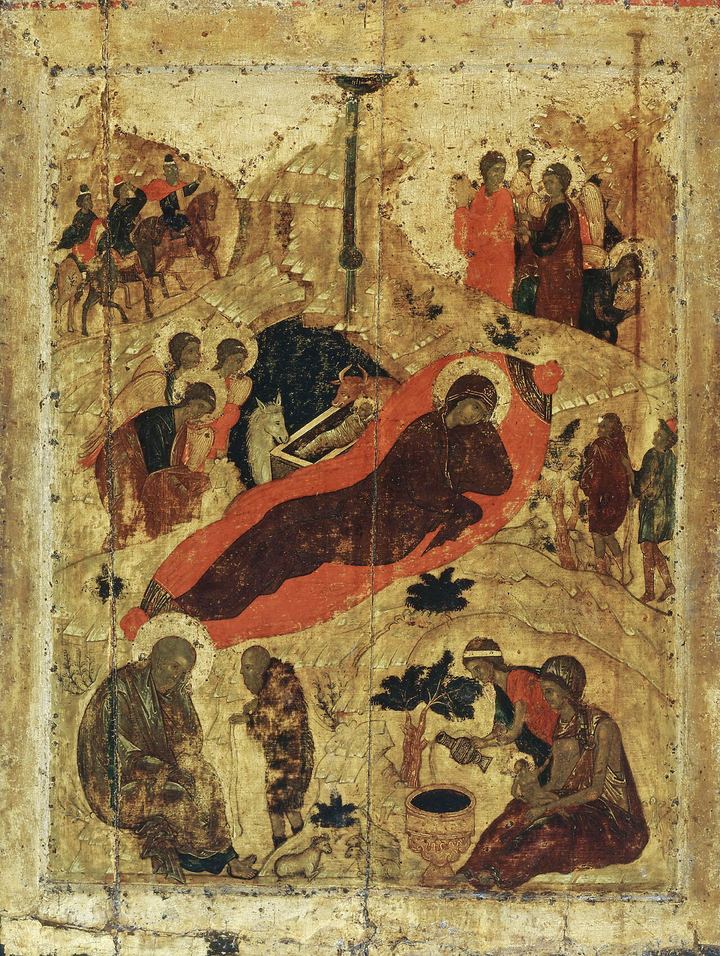
- The cave. Christ is born in a dark cave in the mountain, the darkness of the fallen world, which His light now fills.
- The Child in the manger. He is wrapped in bands like a burial shroud, and the manger looks like a tomb: He was born to die and rise for us.
- The ox and the donkey. "The ox knows its owner, and the donkey its master's crib" (Isaiah 1:3). They lean over the manger, recognising their Lord.
- The Theotokos. She lies on a red cushion at the centre, often looking away from the Child, pondering "all these things in her heart" (Luke 2:19).
- Joseph. He sits apart, troubled, while an old man, often read as the tempter, whispers doubts to him. He is the one who has to believe without seeing.
- The midwives. Two women wash the Child, a detail from the old story of the Protevangelium that shows He was truly born as a man.
- The star. A single ray comes down from heaven to the cave, from the circle that stands for God.
- Angels, shepherds and Magi. The angels give glory, an angel brings the news to the shepherds, and the Magi ride in from the East: heaven and earth, the poor and the wise, all come.
The story of the midwives and of Joseph's doubts comes from The Protevangelium of James, in our library. For how to read any icon, see What icons mean.
December 24 · January 6
Christmas Eve
Christmas Eve is the last and strictest day of the forty-day Nativity Fast. Many Orthodox eat nothing until the evening Liturgy is over, or, in Slavic custom, until the first star appears in the sky, remembering the star of Bethlehem.
Then comes the Christmas Eve supper, still meatless, and in Ukrainian and Belarusian homes made of twelve dishes. The fast ends after the Christmas Liturgy, and from then until the eve of Theophany there is no fasting at all, not even on Wednesdays and Fridays.
Around the Orthodox world
Christmas traditions
Every Orthodox people keeps the same feast in its own way. A few of the best known customs:
Ukraine and Belarus
On Christmas Eve the family waits for the first star before sitting down to the Holy Supper, traditionally twelve meatless dishes for the twelve apostles, beginning with kutia, wheat boiled with honey and poppy seeds. Carollers go from house to house with a star on a pole, and in Ukraine a sheaf of wheat called the didukh stands in the corner.
Russia
Christmas Eve is Sochelnik, named for sochivo, wheat or rice soaked and sweetened with honey, eaten at a quiet meal after the evening services. The All-Night Vigil follows, and the decorated tree from New Year often stays up for Christmas.
Serbia
On Christmas Eve a young oak branch, the badnjak, is brought in and burned, and churches light bonfires in their courtyards. Straw is spread on the floor for the manger. On Christmas Day the family breaks the česnica, a round bread with a coin baked inside, and greets everyone with "Christ is born!" and "Truly He is born!"
Greece and Cyprus
Children go door to door on Christmas Eve morning singing the kalanta with a little triangle. The table has christopsomo, "Christ's bread," marked with a cross. Gifts often wait for New Year's Day, the feast of St. Basil, when the vasilopita is cut and whoever finds the coin has a blessed year.
Romania
Groups of carollers sing the colinde through the village, and boys carry the Star, a paper star with an icon of the Nativity at its centre, singing of the Magi.
Georgia
On January 7 the Alilo procession fills the streets: people in white with crosses and banners singing carols and collecting food and gifts for the poor.
Bethlehem
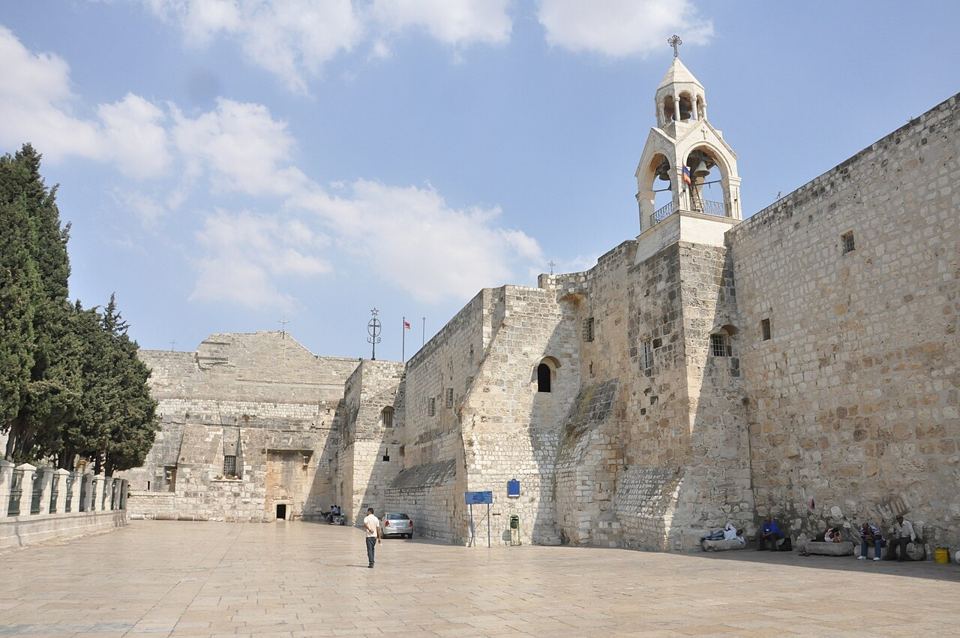
On January 6 the Patriarch of Jerusalem goes in procession to Bethlehem for the night services at the Church of the Nativity, built over the cave where Christians have honoured the birth of Christ since the 300s.
December 25 to January 6
The twelve days
Christmas doesn't end on the 25th. The days up to Theophany are a festive, fast-free season, with feasts along the way. Old Calendar dates are in brackets.
- Dec 26(Jan 8)The Synaxis of the Theotokos, honouring the Mother of God the day after she gave birth.
- Dec 27(Jan 9)St. Stephen, the first martyr.
- Dec 29(Jan 11)The Holy Innocents, the children of Bethlehem killed by Herod.
- Sunday afterChristmasSts. Joseph, David and James, the Betrothed, the King and the Brother of the Lord.
- Jan 1(Jan 14)The Circumcision of Christ and St. Basil the Great, with the vasilopita in Greek homes.
- Jan 5(Jan 18)The Eve of Theophany, a strict fast day again.
- Jan 6(Jan 19)Theophany, the baptism of Christ in the Jordan and the Great Blessing of Waters.
Greet one another
"Christ is born!"
From Christmas until Theophany, Orthodox Christians greet each other with "Christ is born!" and answer "Glorify Him!" Here it is in a few languages. There are more on our Nativity Fast page.
Questions
Common questions
Is Orthodox Christmas on January 7?
For the churches that keep the Julian calendar, yes: Russia, Serbia, Georgia, Jerusalem and others celebrate on January 7. Churches on the Revised Julian calendar, like Greece, Romania, Antioch and the Orthodox Church in America, celebrate on December 25 with Western Christians.
Why is Orthodox Christmas later than Western Christmas?
It isn't really later. Both keep December 25. The Julian calendar is now thirteen days behind the civil Gregorian calendar, so December 25 on the Julian calendar falls on January 7 on ours.
When is Orthodox Christmas in 2027?
For Old Calendar churches, Thursday, January 7, 2027. For New Calendar churches, Friday, December 25, 2026.
Will it always be January 7?
No. The Julian calendar slips one more day behind in each century year that isn't divisible by 400. From 2101, Julian December 25 will fall on January 8.
Do Orthodox Christians fast before Christmas?
Yes. The Nativity Fast runs for forty days, from November 15 to December 24 (November 28 to January 6 on the Old Calendar), and Christmas Eve is a strict fast day.
Can you eat meat on Orthodox Christmas Eve?
No. Christmas Eve is the last and strictest day of the fast, and the traditional Christmas Eve suppers are meatless. The fast ends after the Christmas Liturgy.
Do Orthodox Christians exchange gifts at Christmas?
Many do, but customs differ. Some families give gifts on St. Nicholas Day (December 6), many Greeks on St. Basil's Day (January 1), and others on Christmas itself.
Do Orthodox Christians have Christmas trees?
Many do. The tree came into Orthodox countries from Western Europe in the 1800s and is now common, especially in Russia, where it often stays up through New Year.
Keep going
For the season
Sources
Sources and further reading
Scripture
- Luke 2:1–20; Matthew 1:18–2:12The birth of Christ, the shepherds and the Magi
- Isaiah 1:3, 7:14, 9:6; Micah 5:2; Galatians 4:4The prophecies and the hymns built on them
The Fathers and the services
- St. Gregory the Theologian, On the Nativity of Christ (Oration 38)The sermon the Christmas canon is built on
- St. Ephrem the Syrian, Hymns on the Nativity
- The Protevangelium of JamesThe source of the midwives and Joseph's doubts in the icon
- St. John Chrysostom, Homily on the Birthday of Our Saviour (Antioch, 386)On the feast arriving in Antioch
- The Festal Menaion, translated by Mother Mary and Kallistos Ware (Faber, 1969)The full services of Christmas in English
History
- The Chronograph of 354 (the Philocalian Calendar)The first record of December 25, from a Roman list of 336
- Thomas J. Talley, The Origins of the Liturgical Year (Pueblo, 1986)The two theories about the date
- Andrew McGowan, "How December 25 Became Christmas," Bible Review (2002)
Photos and icons
From Wikimedia Commons. Tap one to see its full credit and licence.
- Nativity (15th c., Annunciation Cathedral in Moscow): Andrei Rublev, public domain
- Gregor-Chora (cropped): Unknown author, Copyrighted free use
- Johnchrysostom: Unknown iconographer, public domain
- Church of the Nativity (7703592746): Neil Ward, CC BY 2.0
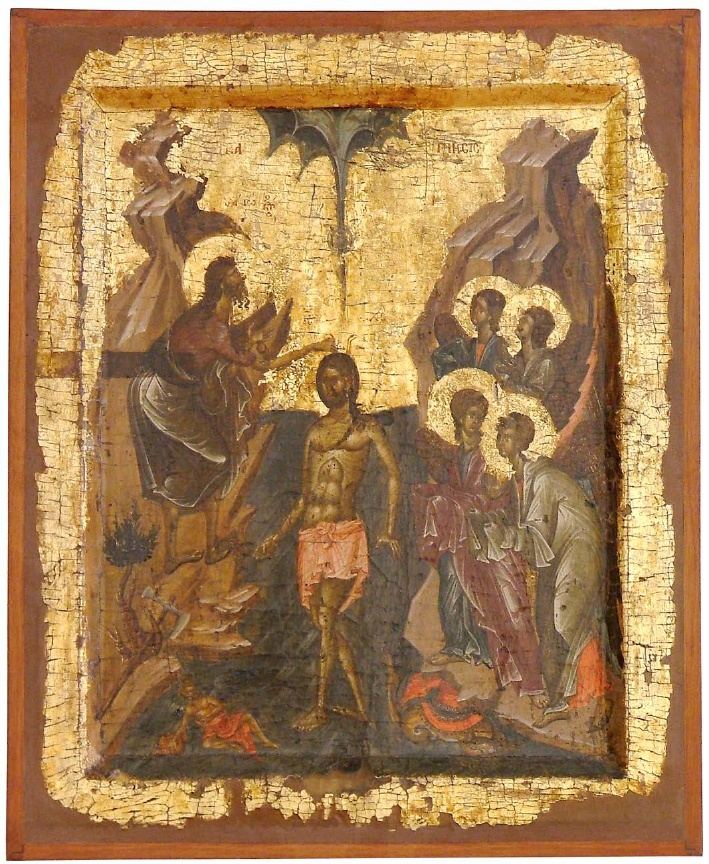
- Baptism of Christ, Early XIV Century, St Mary Perivleptos Church, Ohrid Icon Gal…: Unknown author, public domain
Keep the feast together
The Eastern Cross is a Discord server for Orthodox Christians and people looking into Orthodoxy, on both calendars. Come and say "Christ is born!"
Request Entry